The fox knows many things, but the hedgehog knows one big thing. Start here: https://bayesianfox.blogspot.com/2010/12/genesis.html
Wednesday, January 18, 2017
The Antifragility of the New England Patriots
I've been reading Antifragile by Nassim Nicholas Taleb lately and have become transfixed with his ideas. It's difficult to summarize the book because the ideas are so grand in scope, but one of the examples he talks about is building an investment portfolio that is protected from Black Swan events.
He recommends the barbell strategy, which he says will protect you from risks of volatility while still allowing you to benefit from its rewards, thus making it antifragile. Like any investment strategy, the idea is that you don't put all your eggs in one basket, you diversify, expecting that some of your investments will fail.
I think about these ideas when I think about this weekend's match up between the New England Patriots and the Pittsburgh Steelers. Not as much as how these teams match up with each other, but rather how they are built to last a season.
Pittsburgh has arguably the best running back and best receiver in the game, along with a top-notch quarterback. But should one of them suffer an injury, does anyone really think they would still find success?
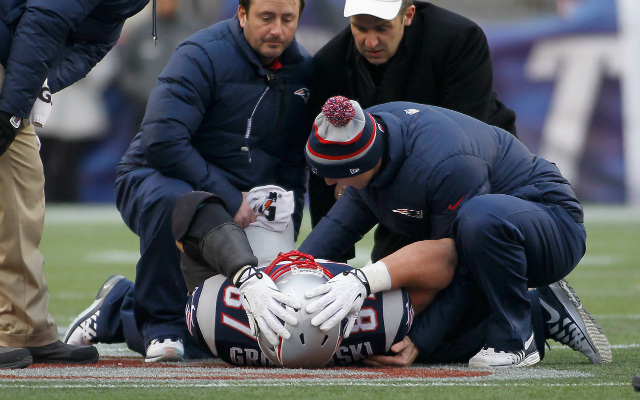
The Patriots, on the other hand, have the best quarterback and the best tight end. Without them? Tom Brady missed 4 games and the team went 3-1. The team hasn't lost a game since losing Rob Gronkowski to injury in early December. The Patriots may not be antifragile (strengthened by volatility) but their coach/GM Bill Belichick manages this team like an investment portfolio more so than any other GM.
Belichick never chases big free agents, cuts/trades guys a year too soon rather than too late, is careful about whom he extends long contracts to, and favors quantity over quality when it comes to drafting (i.e., two second round picks is better than one first round pick). Why? He expects Black Swan events and builds a team immune to such scenarios. That is why they can withstand a Gronk injury or Brady suspension.
With Martellus Bennett and Jimmy Garappolo, the Patriots are protected from volatility. With huge contracts given out to Brock Osweiler and Derrell Revis, their respective teams are harmed by volatility in the form of sucking and old age. Players are investments and smart GMs better diversify their portfolio.
Wednesday, November 9, 2016
Optimism for a Trump Presidency
Now that we have come down off that ledge and realized we're not actually moving to Canada, here are five optimistic reasons the Trump presidency won't be as bad as we think.
Branding
You can say that he inherited his wealth. You can say that he almost squandered his money away via bankruptcy but the banks allowed him to restructure his debt, deeming him too big to fail. But in all honesty, he is a master of branding. The only thing more shocking than how much of a ripoff Trump University was is how many people actually paid money to enroll there. Like him or not, he made his name synonymous with wealth and success.
Why is this important? Because now that he's president, America is his brand. He cares a great deal what other people think of him (almost to a fault ... no, definitely to a fault) and will want to make decisions based on how the country will look, not just himself. This is one of the reasons I think he won't fulfill his craziest ideas.
From The New Yorker:
The Looming Recession
Many economists are predicting a recession in the near future. Like most recessions, they happen in spite of the letter appearing after the name of the president in office. Like most elections, people still punish or reward incumbents based on economic performance, even if it's out of their control. In other words, the economy will tank, Trump will get the blame, and he probably won't see a second term.
Isolationism will be tested
This move toward isolationism/nationalism is not going away. Now that Trump is president, if rejecting open trade and closing our borders to immigrants is as disastrous as most economists agree it will be, that gives voters empirical evidence that these ideas do not work for the next election. No more speculating. It didn't work; let's move on.
Checks and Balances
Don't forget: the executive branch still has limited power. From FiveThirtyEight:
Part of the fear of a Trump presidency is the mystery. His policy proposals are vague and he has no prior history of public office on which to draw. Because he is such a blank slate, he allows us to project our worst fears onto him. This is human nature, survival instinct, to fear the unknown. Once we acknowledge this fact we'll realize that, in all likelihood, a Trump presidency won't be as frightening as we fear.
Branding
You can say that he inherited his wealth. You can say that he almost squandered his money away via bankruptcy but the banks allowed him to restructure his debt, deeming him too big to fail. But in all honesty, he is a master of branding. The only thing more shocking than how much of a ripoff Trump University was is how many people actually paid money to enroll there. Like him or not, he made his name synonymous with wealth and success.
Why is this important? Because now that he's president, America is his brand. He cares a great deal what other people think of him (almost to a fault ... no, definitely to a fault) and will want to make decisions based on how the country will look, not just himself. This is one of the reasons I think he won't fulfill his craziest ideas.
From The New Yorker:
"Trump’s Presidential plans are not shaped by ideology. He changed parties five times between 1999 and 2012, and, early on the campaign trail, he praised parts of Planned Parenthood (while opposing abortion), vowed to protect Social Security, and supported gay rights (while opposing same-sex marriage). He is governed, above all, by his faith in the ultimate power of transaction..."
The Looming Recession
Many economists are predicting a recession in the near future. Like most recessions, they happen in spite of the letter appearing after the name of the president in office. Like most elections, people still punish or reward incumbents based on economic performance, even if it's out of their control. In other words, the economy will tank, Trump will get the blame, and he probably won't see a second term.
Isolationism will be tested
This move toward isolationism/nationalism is not going away. Now that Trump is president, if rejecting open trade and closing our borders to immigrants is as disastrous as most economists agree it will be, that gives voters empirical evidence that these ideas do not work for the next election. No more speculating. It didn't work; let's move on.
Checks and Balances
Don't forget: the executive branch still has limited power. From FiveThirtyEight:
"Immediately, Trump has the executive power to do things like pull out of the Trans-Pacific Partnership trade policy negotiations, restart exploration of the Keystone pipeline, sign executive orders deregulating energy prices and bring trade cases against China. And much more.Fearing Fear Itself
Many of Trump’s major economic promises, however, would require cooperation with Congress and/or the Supreme Court. So repealing Obamacare, cutting taxes and building his infamous wall on the Mexican border — Trump couldn’t do that unilaterally. Bipartisan legislation would more likely come in the form of an infrastructure package or a bill on paid maternity leave."
Part of the fear of a Trump presidency is the mystery. His policy proposals are vague and he has no prior history of public office on which to draw. Because he is such a blank slate, he allows us to project our worst fears onto him. This is human nature, survival instinct, to fear the unknown. Once we acknowledge this fact we'll realize that, in all likelihood, a Trump presidency won't be as frightening as we fear.
Thursday, October 20, 2016
Do Conservatives Need a Trigger Warning Before NFL Games?
The whole exchange made me think of Jonathan Haidt's Moral Foundations Theory. Holley is referencing the care/harm principle when speaking of violence against women. The caller is referencing the authority/subversion principle when speaking of Kaepernick.
The fact that liberals are more upset about domestic violence and conservatives are more upset about kneeling during the national anthem should come as no surprise. Haidt's research shows that not all principles are created equal.
As you can see above, the more liberal you are, the more you only care about the care/harm principle and the fairness principle. Likewise, the more conservative you are, the more you care about the authority/subversion principle. Rather than argue who's right and who's wrong, I'll just paraphrase Arthur Schopenhauer and say that while we can choose what we do, we cannot choose what we want or even care about.
Reading and hearing about the outrage against Kaepernick, the word I hear the most is "offensive." People are offended by his action. Interestingly, this is the same word I hear when I read about arguments in favor of trigger warnings.
Will this be a teachable moment when conservatives understand the plight of those easily-offended, oversensitive liberals? Will liberals extend an olive branch to conservatives and respect their right to not want to be exposed to images they find offensive. Of course not, this is 2016!
Thursday, July 28, 2016
Ortiz and Brady know now what they knew then...and can still bring it
At ages 38 and 40, Tom Brady and David Ortiz are doing something remarkable. Not only do these guys have a combined 7 rings but their performance is peaking when it should be declining.
So let's go where no Boston sports fan wants to go and talk about what every other loser fan base believes to be true: steroids. Don't worry, I'm not about to micturate upon everyone's Kellogg's. In fact, I'd like to argue in favor of steroids.
One of the favorite phrases of middle aged men is "If I had know then what I know now." A bromide that seems to suggest the peak of our youthfulness takes place well before we've ascertained enough knowledge and experience to put it to good use.
According to Wired, most athletes start to decline physically after age 26. So that should have been the best years of Ortiz and Brady, no? Let's look at how these old men compare to their younger selves:
- David Ortiz, 2002: 125 games, 20 HR, 70 RBI, .839 OPS
- David Ortiz, 2016*: 92 games, 25 HR, 84 RBI, 1.071 OPS
*(as of July 28)
- Tom Brady, 2004: 16 games, 60% completion, 3692 yards, 28 TD, 14 INT, 92.6 rating
- Tom Brady, 2015-16: 16 games, 64.4% completion, 4770 yards, 36 TD, 7 INT, 102.2 rating
Let's assume both are taking steroids, at least in this stage of their careers. Are we to assume that it not only staves off the aging process, but it makes them better physically than their supposed peak physical years, or is something else going on?
Here's what I think: What we're seeing with seasoned athletes like Ortiz and Brady is the culmination of professional experience that allows them to see a two-seam fastball and read a Cover 2 defense like never before. Should steroids be a factor, all it's doing is preventing the decline of their physical abilities, allowing us to see—perhaps for the first time—what it would look like to put the mind of a crafty veteran into the body of a youthful rookie.
Why should we waste valuable minds because their bodies can't keep up? Steroids are allowing us to see athletes like we've never seen before. And the difference is not because of their bodies, but their minds.
Monday, May 9, 2016
The Tyson Zone
Bill Simmons coined the term "the Tyson Zone" to describe a person who's ridiculousness has reached a point where you can't tell which stories about them are made up and which are 100 percent true.
I think it's safe to say Donald Trump has reached the Tyson Zone.
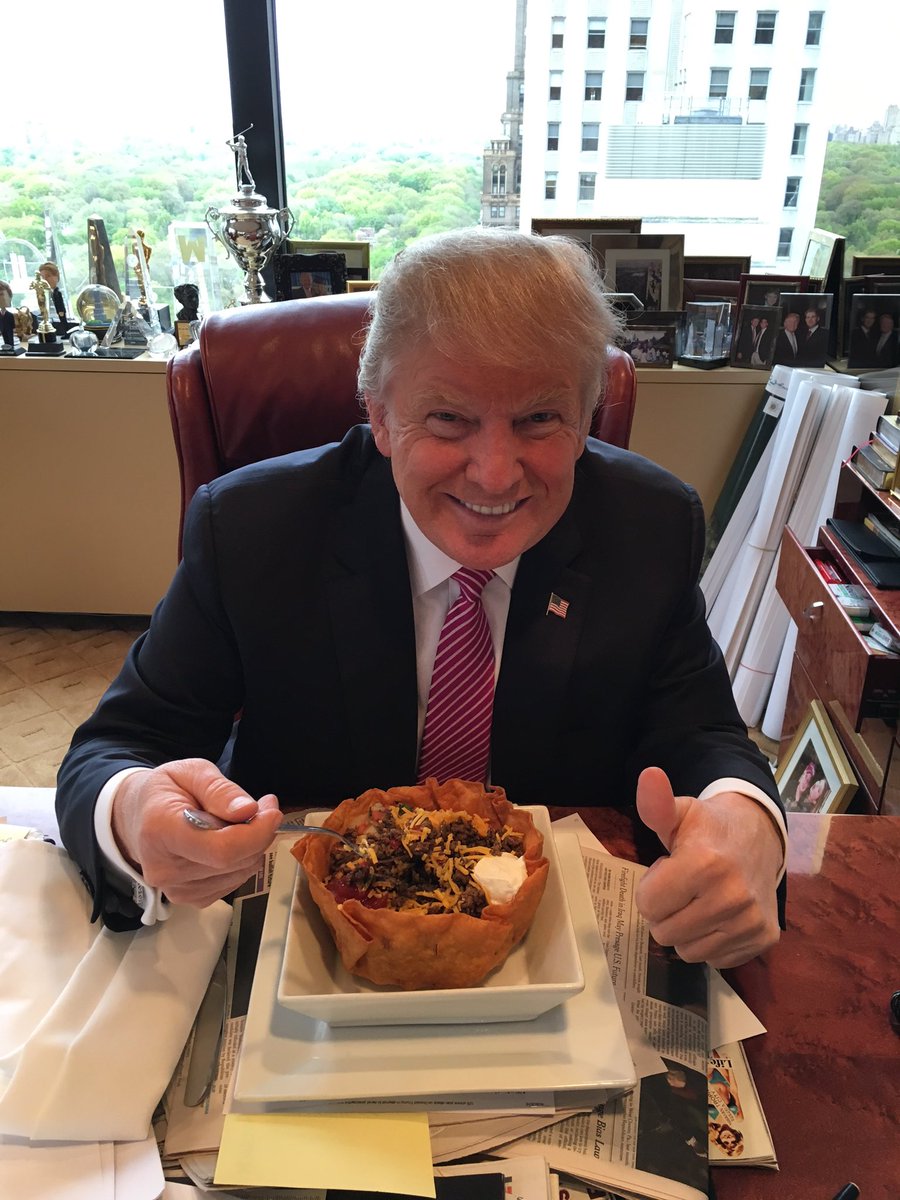
Did he call Mexican immigrants murderers and rapists? Yep. Did he attempt to win over Latino voters by posting an image of himself eating taco salad with the caption "I love Hispanics." Oh, yeah.
One of my favorite columns from the now-defunct Grantland was titled, Unreality TV. The author came to the realization that it's difficult to see the distinction between parody sites like The Onion or political news like The Daily Show, from actual news sources like Fox News. (I spent a long time trying to think of a progressive equivalent. While there are many mediums as transparently biased as Fox News, nothing quite reaches its level of absurdity.) To quote the author:
"But who gets their news from real news anymore? We get our news from morning-after viral videos attacking the real news, or from videos attacking the videos. Our entertainment becomes a kind of horror. Our horror becomes a kind of entertainment. The lines between irony and truth blur in ways we barely notice...So many Facebook users mistake Onion links for real news that the social network is testing a “satire” flag."After watching a Seth Meyers bit about how underpaid teachers are, and a John Oliver segment on how often scientific studies are misrepresented in the news, something struck me: This is what real journalism is supposed to look like. There was actually a lot of work behind these stories, and it wasn't just writing jokes.
It's easy to brush the two hosts off for a lack of seriousness but the topics are so tragic that they're actually funny when someone points out the absurdness of it all. And I would argue that it takes more work to deliver the story in a way that makes us laugh. How else could we take it?
Wednesday, January 13, 2016
Why Fiction Fans Should Watch Basketball
One of the things David Stern did to build up the NBA to what it is today is to change it from a "team" league to a "players" league. It went from the Showtime Lakers and Bad Boys Pistons to Magic's Lakers and Bird's Celtics, eventually culminating in Jordan's Bulls.
My favorite sport to watch is NBA basketball or my St. Bonaventure Bonnies men's basketball. The NBA is the only sport I will flip on just to watch a good game.
In the NFL, if it's not the Patriots or one of my fantasy players, I'm not interested. Same with baseball and my Red Sox. Coming to the very place I work is the Hoop Hall Classic, bringing some of the most talented high school players in the country. It will be a packed event, and yet, I have no interest.
I realized that I'm not really a sports fan. I don't like the game of basketball. I follow narratives. Because the NBA is such a players' league, I know a lot of the backgrounds of the players and can follow their narratives as they play out before me.
When my wife and I went to a Bonnies game recently, I was pointing out all the narratives: "There's Dion Wright. We're the only school in the country to offer him a Division I scholarship. Now he's leading the conference in double doubles." "There's Jaylen Adams. His promising first year last season was cut short by injury. Now he's quickly becoming the most dominant player on the team."
I cheer for the players because I am cheering for their story. I appreciate the complexities of the game, but it always comes secondary. Without a narrative, it's not enough to sustain my interest.
Wednesday, December 9, 2015
The Dying Dialectic
The worst thing about social media is that it gives a voice to the stupid.
I worry that we are losing the concept of the dialectic. In fact, I wish we could eliminate the word "argument" from our language and replace it with "conversation." Dialogue should be about two people, eschewing pathos, logically laying out their points and counter points. If done correctly, the end result is that both parties are better informed than before the conversation began.
The second worst thing about social media is that the first person to make a Nazi comparison wins the argument.
Watch two people on Facebook have a debate about guns. With all the red herrings and strawman arguments it's like a logical fallacy convention. Any attempt at rationality is drowned in a sea of over-the-top accusations.
If you want to change abortion, gun culture, healthcare, or foreign policy, you'll never get there by insulting the other side. You will need a good portion of those people to come to your side and shaming them will never work. You'll have to find common ground and that will only happen through a dialectic approach.
Subscribe to:
Posts (Atom)