Thursday, March 11, 2021

Balancing Action and Theory


 "The best lack all conviction, while the worst are full of passionate intensity." 
William Butler Yeats
I.

There is a scene in Waking Life where four young men are walking down a street, taking turns mumbling about their nihilistic philosophies. Here is an excerpt from the transcript:

"Society is a fraud so complete and venal that it demands to be destroyed beyond the power of memory to recall its existence....
"To rupture the spell of the ideology of the commodified consumer society so that our repressed desires of a more authentic nature can come forward."

So ... yeah.

Eventually, they come across a man on top of a telephone pole. They ask him what he's doing up there and the old man replies, "Well, I'm not sure."

As the four young men walk away, one quips, "Stupid bastard." To which another replies, "No worse than us. He's all action and no theory. We're all theory and no action."

II.

The people who loot neighborhood businesses and tear down the statue of Ulysses Grant are all action and no theory. The people who set up police-free, autonomous zones are all action and no theory. The insurrectionists who storm the Capitol are all action and no theory.

Then there are people who are all theory and no action, like think tanks, policy analysts, and bloggers (hey!). They do fascinating research and write compelling think pieces but rarely leave the office to try and change things.

Another way to think of theory vs. action is Yuval Levin's idea of formative vs. performative institutions. A formative institution is one which shapes an individual; a performative institution is one that individuals use as a platform to build their brand.

All-Action activism tends to be performative and ineffective because its movement lacks theory and direction. It focuses on the Other (marginalized groups) and ways to improve their lives. But its lack of improving the self leads to individuals who are nasty and ineffective.

The most staunch antiracists are some of the meanest people I have ever met. You don't need a bible to see that they are motivated by the deadly sin of anger and wrath. The third principle of the Theory of Enchantment (itself a formative institution) is to root everything you do in love. It's not hard to distinguish the antiracists who act out of love from those who act out of anger, the former will always be the most successful activists.

Theory is built in a formative institution, usually a church (actually the best formative institution is the military, but that shapes people for war, which isn't relevant for what I'm talking about). But sometimes churches are, well, selfish. They can de-emphasize action directed toward others and instead focus on getting one's self into heaven. They aren't always designed to create meaningful change through action. Sometimes a lot of it just sounds like the nihilistic philosophers from Waking Life, all theory and no action monks who kneel and pray all day (to be fair you also have nuns who build hospitals and schools.)

III.

Most "activism" I see today is the opposite: it's performative. It's designed to get the attention of people who are likely to, or already do, agree with you. It's people going to progressive colleges to give lectures about white supremacy. It's screenshotting a letter to your boss and posting it on Twitter. It's Antifa standing up to fascism by marching through Portland, the most liberal city in America.

MLK activism, however, was noticeably different. It was designed to get the attention of people who disagreed with you. It was the melding of formative roots (theory) put into performance (action).

Dr. Keita makes a great point, the all-action/no theory people are making it uncomfortable for the powers that be. And the all-theory, no-action bloggers can just be ignored. But the "creative tension" of the Civil Rights movement seemed more purposeful and I think that's because of the people leading the charge.

IV.

The rituals of formative institutions are helpful in that they restrain our worst impulses. In Philip Gorski's American Covenant, he talks about how Puritans viewed freedom as being more than what libertarians harp on about. From a religious perspective, it was being free from our own passions. In his famous speech that I love to reference, David Foster Wallace wrote about what happens when we give into these passions:

"And the compelling reason for maybe choosing some sort of god or spiritual-type thing to worship—be it JC or Allah, be it YHWH or the Wiccan Mother Goddess, or the Four Noble Truths, or some inviolable set of ethical principles—is that pretty much anything else you worship will eat you alive. If you worship money and things, if they are where you tap real meaning in life, then you will never have enough, never feel you have enough. It’s the truth. Worship your body and beauty and sexual allure and you will always feel ugly...

Worship power, you will end up feeling weak and afraid, and you will need ever more power over others to numb you to your own fear. Worship your intellect, being seen as smart, you will end up feeling stupid, a fraud, always on the verge of being found out."

Without the formative institutions that shape character and free us from our own passions, we fall into "all action, no theory" performative demonstrations that always fall flat on their faces and often produce backlash that makes things worse.

In my view, formative institutions are at their best when they do two things. First, they give your mind something to worship (as opposed to compress) so that you can mentally train yourself to be free of your passions. So instead of worshipping money or beauty or power or intellect, we are free to focus our attention on something meaningful. 

Second, they give an answer to Levin's question, "Given my role as (member of formative institution XYZ) how do I respond in this situation?"

I always loved Levin's line because it assumes an individual's responsibility to the public good, which brings me back to Catholicism. 

V.

Martin Marty wore about the two ways Protestant churches view their role. Private Protestantism is primarily concerned with the afterlife and promoted saving souls and individual salvation. Meanwhile, Public Protestantism believes that the way to God is through the transformation of society. (Another way to think of this is the difference between faith and works.) 

Catholicism doesn't fit neatly into either, but it feels more private than public. Catholicism focuses on the self and ways to ensure admission to heaven. 

Sure, Lent is kind of a big deal, which helps free ourselves from our passions. I think that is a good thing. There is a social justice component to Catholic life, which turns attention to the Other and ways to improve public life. 

But these things are not as important as the sacraments and the focus on the self. There are penalties for missing Mass or not going to confession. It's hard to break the sacrament of matrimony (get divorced). You are expected to pray daily.

Conversely, there is no penalty for never helping the poor. There is no expectation to volunteer in your community. Anything you would call Public Catholicism--performative, action-based work--is extra credit stuff. 

As a non-believer (technically apatheist) I still care because my wife is Catholic and we are raising our children Catholic. My oldest goes to Catechism (basically Sunday School) and I'm okay with this because I'm not against religion. But I'd rather be for it. And it's hard when I see what he's learning and none of it has to do with public life or giving him an answer to Levin's question.

To me, Martin Luther King Jr. had the best blending of formative, theory-based roots that could be put into performative, public-facing action. Malcom X, for all the ways he contrasted with King, fit this description as well. I have many thoughts on their legacies, but that is for another post.

For now I just want to say that I've been critical of activism that I thought was too performative and ineffective. But I also recognize that I shy away from action and I actually envy that level of passion. However, there is a reason I shy away from action and it has to do with a calling I am more drawn toward.

VI.

Performative vs. formative. Theory vs. action. Public vs. Private. I think all of these conflicts come down to one thing: the tension between Truth and Justice. 

Justice without Truth will unfairly punish the innocent. Truth without Justice will allow injustice to fester and people to suffer. Both are important but I am just more emotionally drawn to Truth.

I disagree with tax cuts for the rich and think there should be more wealth redistribution. Yet, when then-Senator Kamala Harris tweeted:

... I was bothered because, well, it's just not true. Likewise, what happened to Michael Brown was awful and I hope the pain we feel leads to serious police reform. But when Senators Harris and Warren say he was murdered, that is also a lie. Hate crimes against the gay community are awful, but the Pulse nightclub shooting narrative was a lie and the Matthew Shepard narrative was a lie. I hate Trumpism and bullying but the Covington Catholic narrative was a lie

These are just little white lies but even if they are in the pursuit of Justice I agree with, I feel an obligation to call them out. Part of what holds me back from a stronger pursuit of Justice is a strong commitment I have to Truth. Justice without Truth feels tainted to me. 

But I am more aware now that holding too tight to Truth prevents Justice and I need to find a better balance.

The four young men in the Waking Life scene are concerned with Truth, to the point that they never do anything. The old man represents a Quixotic quest for Justice, to the point his actions aren't producing any results (if it were a more on-the-nose metaphor he'd say he had climbed up the pole to fight white supremacy). It's obvious that both extremes are bad, but what do we optimize for?

Maybe the answer is for everyone to seek a healthy, balanced pursuit of Truth and Justice? Maybe the answer is for society to have equal numbers of Truth-seeking and Justice-seeking individuals pushing back on one another? 

This is a long post and its conclusion is indicative of my blog. I don't feel like I have an answer but at least I feel like I now understand the question.

A Note About Hypocrisy

You're in a courtroom. The bailiff shouts, "All rise!" The judge enters the room, takes his seat, and everyone else takes their seat. 

The judge asks the defense for their opening statement. The defense lawyer stands up, straightens his suit, and begins to explain why his client is not guilty. But halfway through his statement, the judge interrupts him.

"I'm sorry, but there is no way you actually believe that."

"Excuse me?" the defense lawyer asks, befuddled.

"You're only making that argument because your client is paying you to. Last week you were in my courtroom, making the exact opposite argument for a different client. You sir, are a hypocrite. Dismissed!"

Okay, back in the real world.

I see a lot of arguments similar to the above anecdote about hypocrisy. In the context of a courtroom, it sounds absurd. I think that making these hypocrisy arguments absurd should be the norm. If we are concerned with truth, we should approach all debate as if we are in a courtroom.

A recent example is the issue of allowing trans girls (biological males) to compete in girls sports. A conservative will argue against it, saying it's not fair to the (cis) girls and we need to stand up for their rights. A progressive will shout back, "Oh, now you care about women? If you cared about women's rights you wouldn't vote to defund Planned Parenthood. You're only making that argument because you're a transphobe."

The common belief of the social media age is that pointing out someone's hypocrisy is a way to win a debate. It's not.

First of all, it's a very "let he who hath not been a hypocrite cast the first Twitter dunk" scenario. Most people are hypocritical at some point and not in a position to be morally superior in pointing it out in others. Living a morally consistent life is harder than most people think and it's probably a situation where you'd have to worship this belief and compress everything else to be good at it.

Second, so what? If someone mounts a good argument, who cares what the motives are; engage with the argument. 

If you are pro-choice and you read an essay that argues we have a moral imperative to protect a woman's right to choose, do you then search the Twitter history of the writer and try to find a time they were a hypocrite so that you could dismiss the argument you agree with? Of course not. This makes you a hypocrite (Oh, great. Now I'm doing it).

Versions where this line of thinking is acceptable

Jeffrey Sachs does a good job of demonstrating all the instances of conservatives participating in their version of cancel culture. This isn't a good argument that cancel culture doesn't exist, or that it's okay because "people are just being held accountable." BUT, it is a good argument against the idea that cancel culture is strictly a left-wing phenomenon. 

I know it sounds like an argument accusing one side of hypocrisy but it's really a rebuttal of the idea that "Group X is bad because they do this thing I don't like" when in fact Group Y also does the thing you don't like.

This cancel culture scenario is a situation in which impugning motives might be okay. Once you identify the hypocrisy, you then ask: Is the arguer arguing that the Left is bad and using a shoddy example or is the arguer arguing that cancel culture is bad but is blind to all the other instances of it?  

So calling out hypocrisy works if its goal is to change the nature of the debate--what is the person really arguing?

The limitations of this line of thinking

This does not mean that you must engage with every shitty argument on Twitter. But it does mean that you treat good arguments on their merits and do not dismiss them due to the motivations, character, and possible hypocrisy of the arguer. 

A progressive who cares about fairness and women's rights does have to engage with the question of whether allowing trans girls to compete with cis girls is really fair, but they do not have to engage with the person posing the argument if it's obvious they are a conservative who always takes the position: Progressives Are Always Wrong.

In other words, if it's a bad faith argument you do not have to respond to the arguer and get dragged into a culture war debate. But you should grapple with whether there is some truth to the argument, even if that means doing it on your own terms. 

You might end up deciding that a few cis girls not making the cut on their track team is a tradeoff that is worth trans girls being able to live out their true identity, and your original belief will now be that much stronger.

Citing Hypocrites

Christopher Rufo has made a name for himself by being the go-to guy to leak mandatory diversity training sessions that are racially divisive. He is transparent in his belief that Critical Race Theory is bad and has no place in the public square or mandatory training sessions. He's also a hypocrite because he works for the Discovery Institute, which advocates teaching intelligent design in schools.

As someone who believes public schools should teach neither intelligent design nor Critical Race Theory (nor anything that attempts to influence behavior; that's what local, community-based institutions are for, but that's a topic for another post) I can still reference his arguments against CRT even though I'm aware of his hypocrisy. 

He's probably more of the belief that "The left is bad and CRT is a convenient reason why" than "CRT should not be taught in schools because of something something free speech something something racially divisive." But that distinction doesn't matter to me because I still agree with the argument even if the arguer is motivated to think all things from the Left are categorically bad, a position I do not hold. 

I don't trust Rufo's interpretation of what he says these sessions are really about. But sharing screenshots of some of the slides is pretty damning and I don't have any evidence or reason to believe they have been digitally altered in any way. Sure, he's kind of a clown who takes himself too seriously. But despite his smug culture-warrior mentality, he does curate content that I find valuable and no one else seems to be reporting.

A judge's job is not to determine whether or not the defendant is a good person. Her job is to determine whether or not he committed a crime. Likewise, our job in the public arena of discourse is not to determine the motivations of the arguer but the merits of the argument. 

Monday, March 8, 2021

BLM is right about families

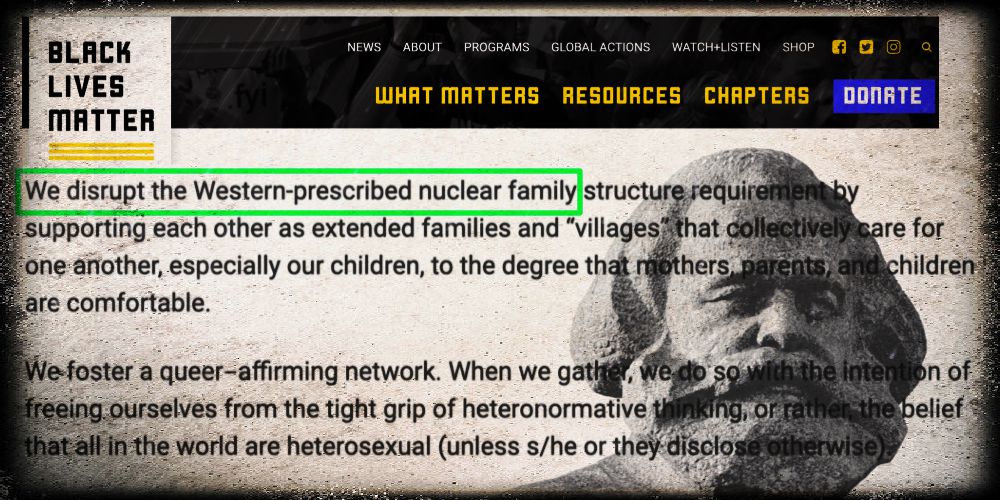
When conservatives aren't complaining about Black Lives Matter-inspired riots, there is one line in the organization's website they love to focus on, (which appears to have been deleted):

"We disrupt the Western-prescribed nuclear family structure requirement by supporting each other as extended families and ‘villages’ that collectively care for one another, especially our children, to the degree that mothers, parents, and children are comfortable,".

I actually think they are right and this is mostly being misinterpreted. I agree with those conservatives that a two-parent family, or "Western-prescribed nuclear family" if you want to call it that, is better than a single-parent family. The data supports this; controlling for all variables, the children of married parents have better life outcomes.

I want to focus on the second part of the sentence: "by supporting each other as extended families and ‘villages’ that collectively care for one another,". The nuclear family is a fairly modern invention and what they are describing here is more in line with how humans behave. It's also lasted longer; very Chesterton's Fence-y.

This article talks about "alloparenting."

If you look around the world, you'll see that in many cultures besides Western culture, and definitely in hunter-gatherer communities, there’s an enormous amount of what’s called “alloparenting.” Allo- is derived from a Greek word meaning “other,” so it just refers to caretakers in a child’s life other than the mom or dad.

These people are deeply involved in the child’s upbringing. Sarah Blaffer Hrdy, an anthropologist, has done some amazing research where she shows that young children are basically designed to be raised by a group of people, not just two—meaning sometimes a mom or a dad is on their own doing the work of several people. So of course we feel worn down and exhausted."

It seems that Black Lives Matter is imagining something similar to this. Of course, I'll believe it when I see it. Our society is not designed to be conducive to this type of parenting. In fact, I think it will be easier to convert more single-parent homes into nuclear homes than alloparenting homes. But I hope I'm wrong and I hope Black Lives Matter leads the way with this type of forward thinking.


Wednesday, February 17, 2021

Diversity Training has a Rationality Problem

I have a theory that for a certain type of person, of which I include myself, resistance to things like racial quotas and mandatory diversity training has nothing to do with wanting to uphold my privilege and more to do with what I reluctantly call "coercion aversion."

To give an analogy, in writing about authoritarian Trump supporters, Jonathan Haidt used the metaphor of a forehead button.

"In times of low moral threat, when [authortarians] perceive that the country is relatively unified and the moral order is not being subverted, they are not particularly intolerant (Stenner finds). But, when they perceive that the moral order is falling apart ... its as though a button is pushed on their forehead that says “in case of moral threat, lock down the borders, kick out those who are different, and punish those who are morally deviant.” 

David Brooks made an interesting point about the failure of diversity trainings, writing:

"Our training model of “teaching people to be good” is based on the illusion that you can change people’s minds and behaviors by presenting them with new information and new thoughts."

The diversity training says "you are biased at the subconscious level. Now you know that and can stop being biased."

I think two things are going on. One is that coercive tactics push the coercion button on my forehead and make me resistant to policies that tell businesses how to do their hiring. Two is that diversity trainings have a rationality problem in that they think they can solve an intuitive problem at the rational level.

Fortunately, I think the work of Richard Thaler and Cass Susstein can provide solutions to both problems.

The Emotional Power of Habit

Has anyone ever successfully lost weight by reading about how it's bad to eat processed foods and enduringly committed themselves to a lifetime of salads? I've gained and lost over 30 pounds countless times and have found two things that have helped me lose weight: diet and exercise. More specifically, making exercise a habit and following Weight Watchers. 

The reason Weight Watchers works is mental. The process of tracking the points value of each meal reinforces the idea that everything you consume has consequences. It makes you accountable for everything that you eat. It also helps with exercise. Thirty minutes on the treadmill means I can have a beer tonight.

In other words, it inculcates a habit. Once you form that habit, the program becomes easier. You don't have to think about it as much. 

It's the same way with exercise. Once working out becomes a habit it no longer feels like a chore but a necessity, like eating or sleeping. 

At the rational level I'm punching calories into an app. At the subconscious level I'm training my mind to cultivate good eating habits. Understanding the logical benefits of weight loss doesn't cause you to lose weight. You have to train your subconscious mind through habituation.

Riding the Elephant

If you want to change someone's mind, Jonathan Haidt said you need to "talk to the elephant, not the rider." Telling someone that their support for Blue Lives Matter is not rational but a reflection of being high on the authority/subversion principle is not going to change their attitudes about ending qualified immunity. That argument is too rational, too meta.

A better method would be to frame your argument so it appeals to a person's intuitive respect for authority. Maybe focus on how police unions incentivize bad behavior by protecting cops who violate the civil liberties and personal freedoms of law-abiding Americans. Worse, it doesn't do enough to protect the good cops who care about justice.

In everyday rhetoric, this is just an appeal to emotion. But on a psychological level, Haidt understood that you don't change behavior by appealing to the rational mind. 

This is what the diversity training referenced in Brooks' article does not get. In fact, most people don't get it. At the structural level, you need policies that affect the subconscious, emotional, intuitive level of the mind if you want to see change.

The best examples of this are Richard Thaler and Cass Susstein's work in Nudge. Sticking with the weight loss example, they found the most effective strategy was to make a bet. Two people who want to lose weight put $100 into a pot. Whoever loses the most weight after six months wins the money. This works  not because people understand that obesity carries certain health risks. It works because of loss aversion; people don't like losing money. They took a universal emotional instinct and showed us how to manipulate it for our own benefit.

Avoiding the Coercion Button

I also think the work of Nudge and libertarian paternalism can help with the coercion aversion resistance to racial hiring quotas. 

An example from Nudge showed that you could increase the chances that a product in the school lunch line will be purchased depending on where you stock it (eye level, right by the register, etc.) They called this choice architecture. What if researchers found that search committees tend to favor the first resume they look at when given a stack of potential candidates?  Using this information, you could make sure that any black candidates appeared first. This would create a positive subconscious bias to combat any implicit bias. 

I do not have a racial essentialist button on my forehead that causes me to oppose any antiracist idea involving racial quotas. But I do have a coercion button on my forehead, which is why my idea of placing black resumes in the most favorable order doesn't bother me. If it works, I actually think it's a great idea.

Libertarian Antiracism

Whatever biases diversity training hopes to correct, it should look for solutions that instill healthy habits of the unconscious mind. In other words, instead of combating negative subconscious biases that are harmful to minorities with rational thinking, they should combat negative subconscious biases with positive subconscious biases that are helpful to minorities. 

This can be achieved by good choice architecture and making tweaks to the environment but we cannot figure out these tweaks without investing in the research (meaning actual science and not critical theory) and holding diversity trainings accountable by measuring whether they do what they say they're going to do.

Thursday, December 24, 2020

Through the Lens of Salience

From The Economist:

"In America the big liberal shift took place in the mid-1960s. To deal with the legacy of slavery, liberals began to concede that you need to treat the descendants of slaves as members of a group, not only as individuals....

“To say that whiteness is a standpoint”, [Robin] DiAngelo writes, “is to say that a significant aspect of white identity is to see oneself as an individual, outside or innocent of race—‘just human’.”

This is a long post about the tension between the center-left individualist identity and far-left groupishness identity. I am going to give examples of how the far left makes tactical errors by viewing individuals, especially individuals who think of themselves as individuals, through a groupish lens. Then I'm going to critique individualism, which is not as individual as most people think it is. Finally, I am going to define my group and how I think it can do better.

I.

After the election, everyone had access to the same data but were drawing different conclusions. Consider the following headlines:

From MSN Newsweek: "Donald Trump Made Gains in Every Demographic Except For White Men". 

Meanwhile, Vox writes: "Election results: White people make up the majority of Trump voters". 

Not to be outdone in the hyperbole department, Charles Blow at the New York Times writes: "Exit Polls Point to the Power of White Patriarchy".

Here's an angle I'd like to see explored: why are White people the most diverse voting bloc? The chart below shows the last two presidential votes by race, the longer the bar the more that race supported a given candidate.


White people are closest to the center, which means they had the most people voting for both parties. No one talks about going after the "white vote" because it is not a monolithic group. People who work on campaigns know that simple truth, yet so many of the far left continue to make that mistake.

Here is another interesting angle: Why are Black Americans the most uniform voting bloc? Nikole Hannah Jones wrote a long Twitter thread about that very topic. 

When you identify with a racial group, you tend to associate others by their racial group. This can lead to oversimplification.

II.

Consider this blog post titled "White Rage, White Guilt." The writer works in a bookstore and describes the post-George Floyd jump in sales for books like  So You Want to Talk About Race and How to Be an Antiracist. The store quickly ran out of books and the employee had to field calls from distressed white women who didn't want to have to wait.

The author then makes this leap in logic:

"And yet, despite all of the learning that supposedly took place via these books, in early November 2020 exit polls stated that among white women, Trump still held their support: An estimated 55 percent of white women voted for Trump."

Forget for a moment the historic inaccuracy of exit polls, which overrepresented in-person (read: Trump) voters and think about how, in 2020, we can observe the behavior of a few white women in an upperclass, well-educated clientele and think it is a good sample of all registered voters nationally. 

Another example comes from an Op-Ed in the New York Times called "‘Reach Out to Trump Supporters,’ They Said. I Tried." After the 2016 election, the writer, Wajahat Ali, went around the country speaking to Trump supporters.

"My standard speech was about how to “build a multicultural coalition of the willing.” My message was that diverse communities, including white Trump supporters, could work together to create a future where all of our children would have an equal shot at the American dream. I assured the audiences that I was not their enemy...

Those in the audience who supported Mr. Trump came up to me and assured me they weren’t racist. They often said they’d enjoyed the talk, if not my politics. Still, not one told me they’d wavered in their support for him. Instead, they repeated conspiracy theories and Fox News talking points about “crooked Hillary.” Others made comments like: “You’re a good, moderate Muslim. How come others aren’t like you?”

In Ohio, I spent 90 minutes on a drive to the airport with a retired Trump supporter. We were cordial to each other, we made jokes and we shared stories about our families. But neither of us changed our outlook. “They’ll never take my guns. Ever,” he told me, explaining that his Facebook feed was filled with articles about how Mrs. Clinton and Democrats would kill the Second Amendment and steal his guns."

I really admire his effort, although I think it was a mistake to make conversion a part of his speech. Ali continues:

"What was my reward? Listening to Mr. Trump’s base chant, “Send her back!” in reference to Representative Ilhan Omar, a Black Muslim woman, who came to America as a refugee. I saw the Republican Party transform the McCloskeys into victims, even though the wealthy St. Louis couple illegally brandished firearms against peaceful B.L.M. protesters."

(This mistake happens on the right too. Most Democratic candidates showed strong support for socialist programs, as well as advocacy for woke culture, which caused many Trump voters to vote against the moderate Biden, including many Latinos. The fact that Biden has been a centrist for his whole career didn't matter, voters took the socialist movement and applied it to the individual.)

The book store owner is wrong because she viewed white women as a monolithic voting bloc, when White people are the most heterodox voting racial group. While there was probably some ideological churn, for the most part it was White Democrats who didn't pay attention to pre-Floyd police brutality who bought your books, not Trump voters. 

Ali is wrong because he assumed the people who talked to him were representative of the broader category of Republicans and Trump voters. The types of people who denigrated  Ilhan Omar and enshrined the McCloskeys are not the type of people who willingly hold polite conversations with a liberal Muslim man.

III.

Is it wrong to categorize people by their race? And why are White people more reluctant to identify by their race?

As a White American, it's hard to understand what it's like to be a person of color in a predominantly white culture that constantly reminds you of your race. For people of color, especially Black Americans, it creates an us/them distinction, which has the effect of unifying "us".

John Turner developed a self-categorization theory. He said that what causes us to adopt one self-categorization as opposed to another is the "relative salience" of that category. What makes a category salient? When a comparable or contrasting category is present.

In The Nurture Assumption, Judith Harris writes:

"Thus, the social category adult is not salient when you're in a roomful of adults, but as soon as some children enter the room it becomes salient....

"When a particular social category is salient and you categorize yourself as a member of it - that is when the group will have the most influence on you. That is when the similarities among the members of a group are most likely to increase and the differences between groups to widen."

For the most part, White Americans are surrounded by other White Americans, making race less salient. So there is less unity, group bonding, and consistent voting patterns. 


The above slide is from a mandatory diversity training session. Look at the bullet points about the racial makeup of politicians; US Congress: 90 percent white, US Governors: 96 percent white, top military advisers: 100 percent white, etc. The implication seems to be that these White people are looking out for all White people, regardless of political affiliation. 

For whoever wrote these slides, race is a salient category. They look at Congress, see a bunch of white faces, and conclude, "these people represent them, not us." White people look at Congress and see good guys (Democrats/Conservatives) and bad guys (Conservatives/Democrats), regardless of race.

Part of what makes diversity training like this so unsuccessful is that the language is made for groupish identitarians and instead is delivered to individualistic people. It tells them: "Your identity is wrong. Stop thinking of yourself as a center-right, small government, civil liberties, Southern Baptist, Dallas Cowboys fan and start thinking of yourself as a White person."

IV.

I think the decline of religion and civic participation has created a need for group bonding, which makes the allure of Robing DiAngelo's message so seductive. 

White Americans are told that it is a privilege to not wear our race as an identity, a privilege that leads to ignorance and harm toward BIPOC populations. Unlike persons of color, White people can never be united as victims of oppression, but the antiracists offer them something better. They can distinguish themselves from the bad (racist) whites and show they are the good (ally) whites. Instead of race, the salience becomes ideological: wokeness.

Race never informed how White Americans voted because it was not a part of their identity; it wasn't a salient category. Antiracism has now created a wedge among White people: the antiracist allies and the people who are sick of being called racist.

For the antiracist, this isn't even about assuaging white guilt as much as it is giving one's self over to the thrilling feel of belonging to a community that unites over a common enemy: racists. And Dr. Kendi made this distinction very easy: a racist is anyone who is not an antiracist.

Friday, December 18, 2020

Kill the Demon, Destroy the Wall


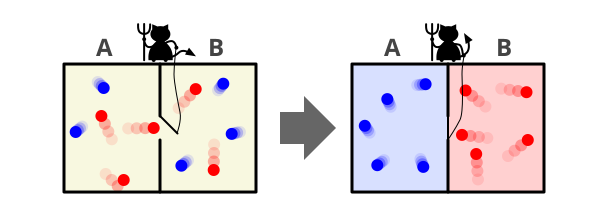
"Maxwell's demon is a thought experiment created by the physicist James Clerk Maxwell in 1867 in which he suggested how the second law of thermodynamics might hypothetically be violated.

In the thought experiment, a demon controls a small door between two compartments of gas. As individual gas molecules approach the door, the demon quickly opens and shuts the door so that only fast molecules are passed into one of the chambers, while only slow molecules are passed into the other. Because faster molecules are hotter, the demon's behaviour causes one chamber to warm up and the other to cool down, thereby decreasing entropy and violating the second law of thermodynamics."

I.

In my review of The Third Pillar, I quoted a reference in the book to a study about schools' gifted student programs. The study found that "there is no overall improvement in results as the benefit to the brightest is cancelled out by the drag on the rest." In other words, putting a student in a gifted program will raise their scores while also lowering the scores of the students in the class the gifted student was removed from.

In a study called The Social Structure of Schooling, researchers found a similar phenomenon when schools used tracking. Put a bunch a smart kids together and their grades go up. Put a bunch of low performing kids together and their grades go down. 

This is Maxwell's Demon in the classroom.

There should be more disorder, more entropy, more poor kids finding success and rich kids falling behind. But there is a demon in our society that interferes, which causes feedback loops we all get stuck in.

You can draw different conclusions from these studies. Maybe you think it means that successful people are only that way because of unearned privilege of being placed in the fast molecule room, or that schools need to spend more on low performing students at the expense of high performing students. But I think the lesson should be that society underrates the impact of peer influence.

The number one villain here is zoning regulations, not a lack of spending on public schools in poor neighborhoods. Mark Zuckerberg's $100 million donation to Newark, NJ public schools didn't work because it did not address the core problem: kids being stuck in the slow molecule room. Infusing the slow molecule room with money isn't the same as infusing it with fast-molecule students. 

Instead, we need to kill the demon and [Ronald Reagan voice] tear down that wall.

II.

It isn't just poor parents without college degrees that are holding their kids back. In The Nurture Assumption, Judith Harris writes:

"British studies have shown that when delinquent London boys move out of their city their delinquency rates decline - even if they move with their families. By living in one neighborhood rather than another, parents can raise or lower the chances that their children will commit crimes, drop out of school, use drugs, or get pregnant."

It's probably wrong to blame the family for a problematic child, often times it's the school and community that influence him.

A New York Times study shows that poor white boys are more likely to become successful than poor black boys, and that rich white boys are more likely to stay rich, while rich black boys are more likely to end up poor, which is disheartening to say the least. 

The NYT study looked for outliers and found that:

"The few neighborhoods  (where poor black boys do well as well as whites)  ... were the places where many lower-income black children had fathers at home. Poor black boys did well in such places, whether their own fathers were present or not.

"Other fathers in the community can provide boys with role models and mentors, researchers say, and their presence may indicate other neighborhood factors that benefit families, like lower incarceration rates and better job opportunities."

This is perfectly in line with Harris's research: It's not the makeup of the child's family that matters, it's the makeup of the families in the child's community.

I've touted the importance and privilege of two-parent families, but I wasn't totally correct. Outside of the home, parents have little influence over their children. Instead, children absorb the values of their peers, which is partially a reflection of their peers' parents. 

The best predictor of a child's future earnings is a combination of their parents' earnings and their friends' parents' earnings. So when towns pass things like single family zoning, they prevent the benefit a disadvantaged child would get from the positive influence of living in that community.

This is Maxwell's Demon in the community.

III.

Here is the problem with tearing down the wall and creating a demon-free society. If you eliminate gifted programs and other opportunities for high income parents to give their kids a leg up, they will just find new ones. The Seattle public schools equity initiative led to high income parents pulling their kids out and putting them in private schools. And even if highly educated parents to opt to mix their kids with low-income students, their children will see a reduction in test scores and an increase in things like dropping out, incarceration, or teen pregnancy (offset by a decrease in those things for low-income children).

The challenge is to create a great enough incentive for high income parents to open the door and let their kids into the slow molecule room and to tweak the settings just right to maximize the benefit of the slow molecules and minimize the harm of the fast molecules. There are a few uphill battles. First, scalability.

Research shows that children learn better in smaller classrooms

"After four years, it was clear that smaller classes did bring substantial improvement in early learning in cognitive subjects such as reading and arithmetic. Following the groups further, the Lasting Benefits Study demonstrated that the positive effects persisted into grades 4, 5, 6, and 7, so that students who had originally been enrolled in smaller classes continued to perform better than their grademates who had started in larger classes."

In small classes, teachers are able to convince students they are a unit so the salience becomes the classroom, rather than race or class distinctions, which have the Maxwell's Demon effect of feedback loops. I mentioned earlier that spending more on education will not fix the problem, but the right kind of spending can help. Any spending to reduce classroom size is a good start.

Second, not just any teacher will do. You need the right classroom leader who can make the classroom unit salient. A leader will define the stereotype the classroom has of itself and prevent students from falling into separate groups that perpetuate the Maxwell's Demon effect. The right teacher, like Miss A, can turn the entire class into an "us" that sees itself as scholars.

Third, you have to get the mix right when you try to de-sort the molecules. Without the right things in place, mixing molecules can make things worse. Janet Schofield's research in the racially-diverse Wexler school showed that students clustered by race and adopted opposing attitudes toward school that became more pronounced over time.

Harris's research found that:

"Whether a classroom of kids will split up into contrasting groups depends partly on how man kids there are ... whether kids will form groups that differ in village of origin, or in race, ethnicity, religion, socioeconomic class, or academic ability, depends on how many there are in these social categories....

Number is important. A few students from a different socioeconomic class, ethnic group, or national background will be assimilated to the majority, but if there are enough of them to form their own group they are likely to remain different and contrast effects may cause the differences to increase. At intermediate numbers, things can go either way: two classes with the same number of majority and minority students may in one case split up into groups and in the other remain united. It will depend on chance events, on the characteristics of the individual children, and, crucially, on the teacher."

The final challenge is stereotype threat. Claude Steele found that all you have to do to lower the score of a bright black kid on a test of academic ability is to give her, before she takes the test, a short questionnaire that includes the question 'Race?' The same thing happens when you test a woman and ask her gender. (There is some evidence of replication failure for stereotype threat.) 

In contexts where gender is less salient, girls and young women do better in science and math. Women's colleges produce a disproportionate number of outstanding female scientists. Likewise historically black colleges and universities produce a disproportionate number of outstanding black scientists. 

This research is a good argument for HBCUs, and unfortunately, a bad argument for black spaces in majority-white colleges.  

Unfortunately we don't know the right number yet to know the ideal settings for getting the most benefit out of peer influence and the best ways to minimize the Maxwell's Demon effect. But if I could wave a magic wand I would do three things.

Reduce classroom size. Reward/retain/attract teachers who are leaders in the classroom.

Abolish single family zoning.

Incentivize highly educated, high income parents to put their kids in low performing schools. 


Thursday, December 17, 2020

Best of 2020

 2020 was a crap year but there was still a lot of good content. Below is my yearly round up.

"War over being nice" by Joseph Gentle

"How Did Americans Lose Faith in Everything?" By Yuval Levin

"The Enemies of Writing" by George Packer

"Unbecoming American" by Johann N. Neem

Best exposition
Nothing about these pieces was exceptionally new or illuminating but they explained the history and context of things like critical theory, classical liberalism, and civilization.

"In America the big liberal shift took place in the mid-1960s. To deal with the legacy of slavery, liberals began to concede that you need to treat the descendants of slaves as members of a group, not only as individuals. Sandra Day O’Connor, the first woman to serve on the Supreme Court, argued that affirmative action, though a breach of liberal individualism that must eventually be dispensed with, had to stay until there was reasonable equality of opportunity between groups.”

“The appeal of critical race theory—or at least its manifestation in popular writing—is partly that it confidently prescribes what should be done to fight injustice...

“Liberals have no such simple prescription. They have always struggled with the idea of power as a lens through which to view the world, notes Michael Freeden of Oxford University. They often deny that groups (rather than individuals) can be legitimate political entities. And so liberal responses to critical race theory can seem like conservative apathy, or even denial."

"Liberalism and Its Discontents" by Francis Fukuyama.

A good history of liberalism, humanism, and Enlightenment values. Why they emerged, their flaws, how they've come under threat, and why they should not be abandoned.

"Markets worked more efficiently if individuals were not constrained by obligations to kin and other social networks. But this kind of individualism has always been at odds with the social proclivities of human beings."

"The Chump Effect" by James B. Meigs.

 A good perspective on the free rider problem in contemporary society.

"Thousands of norms, rules, and traditions make civilized life possible. Some, like paying taxes or not littering, are enshrined in law. Others are informal. Most of us take pride in adhering to basic standards of etiquette and fairness, to say nothing of following the law. And we have a deep emotional investment in having the people around us follow these norms as well. There’s a reason that we call selfish, disruptive, or criminal behavior “antisocial.” We know that if everyone stopped paying their taxes, or started running red lights and shoplifting, our society would be on its way to collapse."

"Slate Star Codex and Silicon Valley’s War Against the Media" by Gideon Lewis-Kraus.

A fair and honest take on Slate Star Codex, Scott Alexander, and rationalism.

My favorite Slate Star Codex essays (RIP)


Shameless Self Love
My favorite writings from yours truly.