Friday, April 14, 2023

Hope is a Good Thing

I recently stumbled across a 2021 song called “Hi Ren” by the artist Ren. Check out the video above. The vibe of the song is familiar but still impressive. But after a few listens I realized that the song went in a new direction I was not expecting.

In one part, Ren breaks the fourth wall and mentions how Eminem and Plan B have already done similar songs to the one he is doing. But I actually think the closest comparison is “U” by Kendrick Lamar. Both songs are the artist, as themselves, having a conversation with themselves about self doubt.


"U" is one of my favorite songs for the same reason that Rue from Euphoria is one of my favorite characters. In one episode, Rue is shown staring at the ceiling and envisioning numbers on a grid and becoming so transfixed that she could not function. In another episode, her mother explains how, as a child, if she kissed Rue goodnight on one cheek she would have to do the same on the other cheek.


One of the best feelings in the world is the feeling of being understood, especially when it seems that no one else understands you. As a child with OCD, I had very similar experiences to Rue and those moments really made me feel seen and understood.


Popular music in the ‘90s was depressing. But young people wanted it that way because it made their depression feel understood. I think the same type of person likes songs like “Hi Ren.” It is the same reason youth are self-diagnosing themselves with various disorders and conditions they hear about on social media. It is the same reason every personality has its own student club.


But there is a problem. Being understood feels good but it’s not a solution. It's like learning the cure for a hangover but continuing to binge drink.


Amanda Ripley wrote a great article about what she feels is a failing of the news. If the news is bleak, by all means, report on the bleakness. But you can still offer hope.


At one point, Ren, singing as his evil alter ego, says things like:

Oh your music is thriving? Delusional guy!
Where's your top ten hit? Where's your interview with Oprah?
Where are your grammies Ren?
Nowhere! ...

Man you sound so pretentious!
Ren your music is so self centred,
No one wants to hear another song about
How much you hate yourself.

That compares well with "U" in which Lamar raps:


I fuckin' tell you fuckin' failure—you ain't no leader!
I never liked you, forever despise you—I don't need ya!
The world don't need ya, don't let them deceive ya
Numbers lie too, fuck your pride too, that's for dedication
Thought money would change you, made you more complacent
Fuckin' hate you, I hope you embrace it,


And while "U" ends with a hint of suicide, Ren goes in a different direction. Speaking as himself, he sings:


Some people know me as hope

Some people know me as the voice that you hear

When u loosen the noose on the rope

And you know how I know that I'll prosper?

Because I stand here beside you today

I have stood in the flames that cremated my brain

And I didn't once flinch or shake

So cower at the man I've become

When I sing from the top of my lungs

That I won't retire I'll stand in your fire

Inspire the weak to be strong


As a society, I think we’ve done an admirable job of normalizing mental health, encouraging suffering people to speak up. But we haven’t done enough to valorize the process of getting better.


Friday, March 17, 2023

Agency Detection and The Confident Pundit

A face designed by some higher power, or just randomness?


I recently had a conversation with a friend and, as usual, we talked about Joe Rogan and conspiracy theories and it made for great blog content.

“Was Fauci compromised by big pharma?” was one of the questions we got hung up on.

One thing we share is that we do not have a lot of information on this topic. As such, we rely on heuristics. And so our disagreement was less about facts and more about which heuristics to rely upon.

I noticed that he was using two common System One, intuitive heuristics: the evil agent heuristic, and the confident pundit heuristic. Because these are intuitive, I think we are all prone to them. I just think there are better, more rational, more System Two heuristics that we should be using.

The confident pundit heuristic

We are naturally drawn toward confidence and, with low levels of information, will put our trust in a confident pundit who claims to have the answers.

Although intuitive, it actually makes sense if you don’t think about it for too long. A confident pundit is putting their reputation on the line, putting skin in the game, so why wouldn’t I believe him? Unfortunately, our current system does not penalize people for being wrong. It’s too easy to move goalposts and double down, especially when the confident pundit rarely says anything specific enough to be proven wrong. Most people have a self-preservation bias and will do mental gymnastics to avoid admitting they were wrong when they stake so much of their reputation to their hot take.

So Bret Weinstein is highly confident when he speaks about his vaccine conspiracy theories. And I don’t have much information, so I can’t challenge his assertions. But his confidence doesn’t move me because he’s really not saying anything falsifiable.

If he said, “Because of my assertions, I predict that the number of people dying from heart related conditions will increase by 25% starting in 2024, and the increase will be entirely among the vaccinated,” I would take him very seriously! But he mostly says things that sound like “we don’t know what these vaccines are going to do and they haven’t been properly assessed.” So his confidence does not move me as it isn’t falsifiable—specific, measurable, and timely. There is nothing he says that we can point to and say “see you were right/wrong!”

So I tend to distrust confident pundits whose opinions are outside the consensus. 

The evil agent heuristic

Agency detection refers to our in-born tendency to look for a man behind the curtains. It’s the reason we see faces in the clouds, but not clouds in faces.

We know the reason some clouds look like elephants isn’t due to God making fluffy balloon animals for us. It’s just randomness; there are many clouds, their shapes are random, and so ever so often one looks like a familiar mammal. So we should extrapolate from there and assume that if we have low levels of information, strange events are probably more likely randomness, like the random shape of clouds and our agency detection thinking they look like Elvis, than evil manipulators making these shapes.

UC Santa Barbara conducted a study where they tested people's abilities to find hidden patterns. Half of the subjects, before the test, either read a Kafka story or watched the David Lynch film Blue Velvet. If you've never seen Blue Velvet, the immediate reaction from most normal people is "What the fuck did I just watch?" In other words, the plots don't make any sense. Those people's scores where better, statistically significant, than the control group.* 

One of the study's psychologists said: "The idea is that when you're exposed to a meaning threat –– something that fundamentally does not make sense –– your brain is going to respond by looking for some other kind of structure within your environment."

JFK

I don’t have a lot of information about the JFK assassination, since I don’t find the topic interesting. But there is one theory that I like.

As far as I understand, the part that doesn’t make sense is that one bullet appears to come from the opposite direction than the ones fired by Oswald, which exposes people to a "meaning threat". This is what leads to the “magic bullet” or second shooter theories. The fact is we do not have much information, which leads to conspiracy theorists who begin with agency detection and the evil manipulator heuristic, and end with the belief that the CIA was behind everything.

The theory I like goes like this. Kennedy’s secret service agent was beside him when he got shot. He reacted by quickly pivoting and returning fire in the direction of Oswald, and Kennedy’s head got in the way, which explains the “magic bullet.” In essence, Kennedy’s own secret service agent was unintentionally the second shooter. The reason for the secrecy is that, well, it’s embarrassing.

Now, this theory is probably just as plausible as anything you’d find in any conspiracy book. But it’s much less popular for the simple fact that it’s fucking boring. There is no evil agent to blame. So given low levels of information, and a high ratio of randomness to evil, I favor the boring explanation.

But sometimes there is evil and the conspiracy theorists are right! Does that mean my boring heuristic is garbage and assuming evil is always the right choice? That depends on how you feel about the Blackjack scene from Swingers.

Always double down on 11

Is Trent (Vaughn) right, or is Mikey (Favreau)? We’re probably asking the wrong question because Trent is actually talking about broad framing. Trent is asserting that if you follow the “always double down on 11” heuristic, in the long run, you’ll make money. Mikey is caught up on his granular experience and how he lost by following that heuristic. (Technically, Mikey is right. If you’re broad framing, you need to have enough capital to avoid going bust after a few initial losses. Plus, there is no successful heuristic in gambling, the house plans for it and always tips the odds in their favor.)

But the point is that Trent and Mikey, like my Rogan-loving friend and I, aren’t arguing about facts but about heuristics. And heuristics shouldn’t be judged on a case-by-case basis, but how often they’re right in the long run.

So my yet-to-be-proven belief, is that if you follow the boring fallacy you will be right more often than the evil fallacy or the confident pundit. I also have an anti-confident bias so I avoid individuals who are overconfident and arrogant, except for a few arrogant people I think are usually right (Nassim Taleb, Eliezer Yudkowsky). Instead I rely on a consensus of experts or pundits who give specific, measurable hot takes; bonus points if they use a confidence interval.

*If the UCSB study was a better example, then it would have shown that the Kafka/Lynch subjects found more false positives (i.e. identified patterns that weren't actually there) than the control group. But this is my favorite study ever and I've been working really hard to find a way to work it into a blog post, so deal with it.

Monday, February 13, 2023

Photoshop is Obsolete. Long Division should be next.


This is a post about why I hate long division. But to get there, we have to talk about Photoshop color modes.

When you open an image in Photoshop, you have the option of choosing one of three color modes (plus grayscale if you want it to be black and white). The default is RGB, which stands for red, green, blue. Any color that shows up on your screen can be reduced to a value between 0 and 255 for red, green, and blue. For instance, an RGB of 53, 94, 59 will give you a nice hunter green color.

The other popular color mode is CMYK; or cyan, magenta, yellow, and black (the k actually stands for “key” but for all intents and purposes let’s call it black). Same thing: you give a value to each of the four colors and that unique combination will produce whatever color you are looking for. This is the color mode used for printing. Open up any commercial grade printer and you will see four toner cartridges labeled, you guess it, cyan, magenta, yellow, and black.

Photoshop also offers a color mode called Lab. The L is for lightness and the a and b are a range of colors, green to red and blue to yellow, respectively. When I was going to Photoshop conferences (a real thing) the Photoshop gurus (real people) were super excited about Lab.

Normally, if you wanted to adjust the lightness of an image (make it darker or brighter) you would use a Photoshop tool like Curves or Levels. Sometimes this had the unintended effect of also changing the value (ie shade) of the colors. So lightening an image might accidentally turn a red pixel into a pink one. Lab solved this by putting lightness on its own channel. Finally, a solution to a problem that only 1% of people actually notice!

Crowding In
All of this is to say that I have a deep knowledge of Photoshop. Most amateurs are interested in learning Photoshop because they want their images to be brighter, darker, sharper, or just to “pop". I had learned myriad ways to get inside images and make them pop.

Then Instagram filters came along and suddenly everyone could do what I could do. Even the default photo editing app on your phone does a good job. At first, I found ways to criticize these techniques; “this isn’t print quality” or “it looks fake,” but it is serving the intended purpose of the user; making it pop so they can share it online.

This trend has continued with Canva, turning any amateur into a halfway decent graphic designer. In fact, this trend started with digital photography in the ‘90s, which made it easy for anyone to be a decent enough photographer. Most non profit marketing teams don’t have a photographer, they just hand a camera to someone (usually the media relations guy) and say “figure this out.”

And he does. It’s not that hard to take “good enough” photos.

All of this has been bad for people who built their careers being highly-sought after professional photographers, graphic designers, and photo editors. But it’s made it really easy for people who cannot afford these services who can now do a “good enough” job and produce more content.

That is the crux of my point; the democratization of the tools didn’t kill my job. I do more digital than print content now, so I just spend less time tweaking photos in Photoshop and more time producing content, which is really what my job is.

Bad Math Dad
I have a ten-year-old who occasionally (when my wife is unavailable) asks me for help with his math homework. Sometimes I can help, but usually I get incredibly frustrated and launch into a tirade about how pointless it all is.

I usually stop there, but this time I decided to lean into my own self righteousness and develop a solid argument for why it is pointless, which you are now going to read.

The fact that I can’t remember complicated long division or how to multiply fractions is a pretty good indicator that learning it was useless for me. That’s not to say math is useless; it’s incredibly important. I use it every day. I just do it with a calculator.

You might counter that not all math can be done via calculator, and that’s exactly my point. Why do we waste time teaching kids things they will end up doing on a calculator? Why not just teach them how to use a calculator to solve simple problems.

Fast Tracking Innovation
Social media managers don’t need to understand color correction in Lab mode. They just take a photo on their phone, make adjustments, and post it to Instagram.

I read somewhere that society advances when we increase the number of things we can do without thinking about it. So how much quicker could we move students along to doing really exciting things in math if we aren’t wasting time with trivial things like memorizing times tables?

There is a story about an elementary school that dropped math from the curriculum, beyond some teaching some basic practice in measuring and counting. Those students rejoined the rest of the district in middle school, with students whose elementary schools had taught them math, and by the end of the year the non-math students' math scores had caught up with everyone else. 

The school dropped math for budgetary reasons, but what if money isn’t an issue for your school? How would you use those extra learning hours to advance knowledge?

My fear is that the reason we still teach these building blocks is the reason some photoshop mavens hate Instagram; it makes their deep knowledge and experience irrelevant.

But I think we have to put the kids first and get past all that. How many kids are we losing each year by forcing them to learn boring, rote memorization of pointless skills they will never use manually? How much sooner could the next generation of math whizzes reach breakthroughs and innovations if they didn’t waste so much time learning building blocks and instead stood on the shoulders of the amazing calculators our society has invented for our convenience?

Or maybe I just really suck at math and this is all cope.

Friday, February 10, 2023

Short Takes: Updating my Priors 2.2023

I once wrote a post pontificating that perhaps the reason US history was told with no contradictions, with America as the hero, was to create a myth to unite a diverse group of citizens. But I think a more likely answer is that a simple narrative is just easier to remember. 

As me move toward a messier, more complicated retelling of our story, my guess is that more students are going to lose track of the overall picture.

Interesting thread on happiness that mirrors my post on trust. Some similarities, poverty and inequality lead to low trust and happiness. It also complicates two of my views: I'm okay with inequality as long as we take care of the people at the bottom. But I also highly value trust, which seems incompatible with high inequality.


Speaking of trust and social capital, I’ve speculated a lot on the decline of social capital; why there is less face-to-face interaction with people outside our homes in younger generations. But maybe the better question is to ask why there was so much face-to-face interaction with the silent generation. 

And maybe the simple, boring answer is that civic participation and social interaction is driven by boredom. And entertainment and technology is so amazing right now that people are never bored enough to leave their homes and find other people to cure their boredom.

I also think this is a better explanation than the one offered by the Let Grow movement, i.e. that kids are stuck inside because their parents are too scared to let them out. My theory is that they don’t want to go out. The idea of meeting up with some neighborhood friends and building their own treehouse is less exciting than doing the same thing virtually on Minecraft.

In my End of Culture post, I pointed out that the proliferation of new movies that are sequels (Top Gun: Maverick, etc.) and TV shows that are spinoffs (Velma, Wednesday, etc.) are a sign of a lack of creativity driven by the Gossip Trap. 

But I think there is a better explanation. 

Research shows that, given low information, a voter will choose the candidate with the familiar name. Likewise, given an abundance of streaming options, and the paradox of choice, a viewer will choose a familiar-sounding show. So spin-offs and sequels are a way for content makers to cut through the noise by giving the viewer a familiar-sounding name.

In The Scout Mindset, Julia Galef uses the example of a climate activist using investment language as an analogy to change the stance of a climate skeptic who worked in finance. I was thinking of this when reading NYT’s "The Morning" when it quoted Biden’s line about going after “junk fees.”

Not knowing much about junk fees, I would have defaulted to feeling like this was some government overreach effort that is probably a net harm, especially if I read it in a column by a leftwing activist with language like "corporate greed" and "the evils of capitalism". But watch how David Leonhardt frames it.

“True, one company could call out another for using [junk fees]. But doing so often requires a complex marketing message that tries to persuade people to overcome their psychological instincts (like the appeal of a low list price). For that reason, Hilton can probably make more money by charging its own sneaky resort fees than by criticizing Marriott’s.”
In other words, our current, unregulated system penalizes companies that don’t engage in junk fees. If they want to stay competitive they have to do it too, even if they don’t want to. The government, in this case, is just resetting the nash equilibrium so there is no longer an incentive to opt out of the prisoner’s dilemma.

I mean, that worked for me. And it reminded me why viewpoint diversity is important for persuasion; you have to know how other people think and talk if you want to change the way they look at things.

Friday, January 27, 2023

The Beautiful


I’ve been struck by this passage from a rationalist essay. It imagines two people arguing over whether minimum wage laws are helpful or hurtful, both citing facts to support their respective cases. Then it zooms out and suggests that it’s really a conversation about aesthetics. In other words, they are really arguing about whether capitalism is beautiful or ugly, which is why facts are often unpersuasive.

(The lead photo of a dense collection of gas stations in Breezewood Pennsylvania is a meme that socialists like to use to argue that capitalism is ugly.)

In The Happiness Hypothesis, Jonathan Haidt describes a patient who has brain damage affecting the emotional part of his brain. Ostensibly, he seems completely normal. But after several failed relationships, he sees a shrink. At the end of a session, the doc asks when he wants to book the next appointment. The patient lists the pros and cons of all possible dates, but cannot decide because he cannot assign any emotional valence to anything. He’s always stuck.

It’s an interesting case study because it suggests that humans actually need to be a little bit emotional in our decision-making. We need to see the beauty in things.

In Zen and the Art of Motorcycle Maintenance, the narrator describes his friend's relationship to his motorcycle. His friend bought a BMW because he didn’t want to deal with any problems. But they invariably happen.

The narrator tries several times to show his friend how to fix his motorcycle, but he stubbornly refuses to even listen. It’s not that he’s lazy or incompetent. Instead, the narrator describes him as a romantic thinker who sees the beauty of the motorcycle, but breaking down its component parts is ugly to him.

So it wasn’t a question about whether or not he should learn how to fix his own motorcycle, it was a question of whether the mechanical parts of a motorcycle are beautiful or ugly.

I think this framing is helpful because sometimes it’s the reason people in dialogue get stuck; they’re arguing about beauty. And you can’t, and shouldn’t, try to convince someone that what they think is beautiful is not.

Sunday, January 15, 2023

Critical Thinking is Overrated


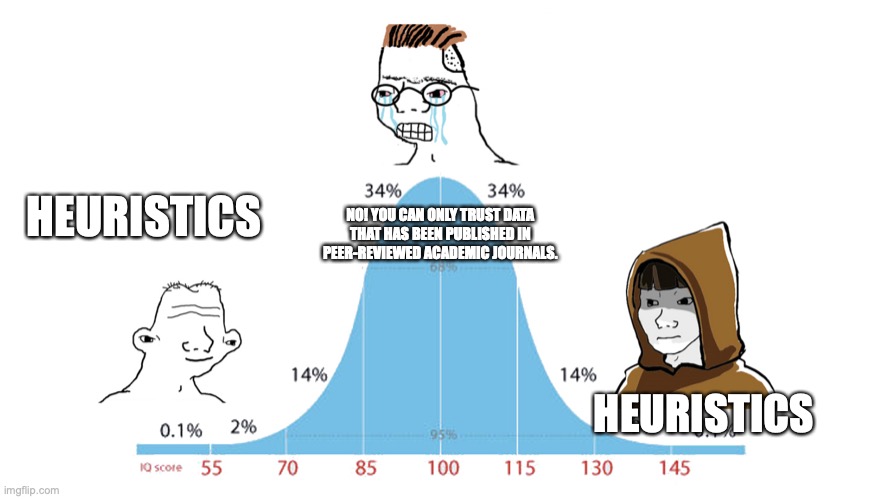
When you have low information, you rely on heuristics, or rules of thumb. As you become more educated, you find yourself telling these low IQ heuristic individuals to “read a book,” “do some research,” “believe in science,” or “trust the facts.” Then you come to realize that there isn’t much consensus among the scientific community and there are a lot of educated people with conflicting beliefs, ie Gibson's Law; “For every PhD, there is an equal and opposite PhD.” 

Eventually you come back to heuristics, only better ones.

I used to think that, eg Christian ethics was dumb, or the people who followed it were dumb. Because instead of trying to decide what was right or wrong (is abortion okay?), true or false (is man-made activity causing the climate to change?), they just did whatever some old book told them, or whatever some credentialed expert in the old book told them the old book said about said topic.

Stupid.

Instead, people should just be open to all ideas and judge situations on a case by case basis.

Also, stupid. Better yet, incredibly time-consuming to the point of debilitating. So heuristics it is.

Good rules and bad rules

The following tweet is instructive of two popular heuristics I see otherwise smart people do a lot: qui bono and the black box fallacy. Yglesias has strong opinions and rising prestige, as evidenced by his popular Substack. So what does the gossip trap phenomenon tell us? People will respond by trying to pull him back in the bucket with the rest of us.

I have to assume the “carry water for the rich” line is in reference to Yglesias’ YIMBYism. There are countless examples of how policies that impact building homes impacts homelessness and the cost of housing, so I have to assume people against YIMBYism have low levels of information. So Sammon relies on the qui bono heuristic; if bad/evil people (ie rich developers) benefit then it must be bad. Which, it should go without saying, is a dumb heuristic. 

(After finding a way to circumvent the WaPo paywall and reading the story, it's more likely that the line is in reference to the story's insinuation that Yglesias has an inside track to influential politicians and writes blog posts that they want him to write; an unproven assertion that seems, I dunno, deeply incurious. But I have read others who argue that YIMBYism is bad simply because developers benefit. So the critique still stands, it just applies to people not mentioned here).

Black Box

The other bad heuristic is what I’m calling the black box fallacy, a reference to a SSC post. Basically, there are countless geniuses who had really dumb ideas. So dismissing Newtonian physics just because Sir Isaac thought there were hidden codes in the Bible would be a bad idea.

I highly doubt Mr. Sammon has a statistical analysis of the errors of journalists that shows Yglesias is among the worst. So he has low information here. Instead, Sammon is probably highly sensitive to the topics in which he’s discovered an Yglesias error, which is really just committing the availability heuristic, (ie his opinion of Yglesias is informed by the blog posts most readily available in Sammon's mind, the ones where he has discovered an error).

But what Sammon is really getting at here is an attack on Yglesias’ growing prestige, since Yglesias seems highly influential in areas that are, I imagine, at odds with Sammon’s beliefs. Sammon can’t possibly know that Yglesias is wrong in every subject he writes about, so Sammon relies on the black box fallacy: if he was really wrong in these instances, then he must be wrong everywhere and can be dismissed without further inquiry.

But more importantly, and I'm definitely impugning motives here, I get the sense that Sammon wants you to think that, because Yglesias was wrong in these instances, he must be wrong everywhere and can be dismissed without further inquiry. He wants to yank down Matt's prestige and influence.

Think Less

I write about situations I find interesting and I find them interesting because I’m not sure what the answer is. But I want to know what the answer is because I want to live my life. So I run through all these scenarios, not because I think judging everything with an open mind, on a case by case basis, is the right approach. I’m doing it to build out a moral framework so, like the Christians and their old book, I can consult my old framework for my response and not have to think.

Going back to the meme I posted at the top, I’m trying to develop heuristics that are are better than the Kahneman default heuristics

Here is one that I like: I call it the boring heuristic. If something seems off, and I have low information, instead of attributing it to something like malice, conflict, corruption, or stupidity, I try to come up with the most boring explanation possible and stick with that.

People in my town are mad that the town is slow to respond to the removal of public trees. We don't have a lot of information on the workings of our local government, so we rely on heuristics for an explanation. Most people default to the evil/stupid fallacy: we have incompetent, lazy people who don't respond to requests or we have corrupt officials who are laundering tax dollars into their own pockets and claiming that there isn't enough money. 

But a more boring explanation like: "There just isn't a lot of money in local government budgets and the town can only remove so many trees in a fiscal year," just seems more plausible to me.

He was right even when he was wrong

I also have a "people with reputations and money on the line are usually right" heuristic. The Matt Yglesias piece in question is paywalled but my super-sleuthing revealed this line from the story:
"At age 21, Yglesias was laying out the logician’s case for the invasion of Iraq, because how could the most powerful, informed men on Earth be so stupid? In May of this year, Yglesias declared that Bankman-Fried “is for real,” because why else would wealthy people risk their money?"
With hindsight, we can see he was wrong in both instances. But if your heuristic for distrusting the Iraq invasion is "never listen to the government" then you're probably going to be wrong a lot and will probably die from a preventable disease for which we have readily available vaccines.

Elsewhere in the article, the journalist praises Revolving Door Project, "which saw right through Sam Bankman-Fried." Good for you, Revolving Door Project. My question is: did you have information no one else did (highly unlikely) or do you have an "all tech people are committing fraud" heuristic (probably)? If the latter, I think you're going to be wrong more often than Yglesias. You just happened to be right w/r/t SBF. I'd be impressed if Revolving Door Project also predicted the Black Lives Matter fraud, but my guess is they were too busy targeting tech billionaire to notice.

I was too worried about finding a framework that would never lead me astray. But that's silly. It's better to settle on heuristics that will be right most frequently over the long haul. 

The only exception to these heuristics, other than having enough information to feel comfortable ignoring them, is the "What if I'm wrong?" question. Like, if following a heuristic leads me to believe Theory A rather than Theory B, I have to ask if choosing Theory A can have devestating consequences if I'm wrong. 

Otherwise, I stick with my boring heuristics. 

Friday, January 6, 2023

The End of Culture


My favorite podcast is called The Rewatchables, which is just three dudes rehashing what they love about an old movie. It has taught me how different subsequent viewings are from the first one. You pay more attention to subtlety rather than trying to follow the plot, because you already know what happens.

The first novel I read in years is called Station Eleven, which is the basis for an HBO series I’ve already watched several times. So I already had a sense of where the plot and character development was going and I could focus on the subtlety.

I just haven’t had the appetite for something new in a while and I don’t think I’m alone. On his Plain English podcast, Derek Thompson says:

“This year, the song of the summer is arguably Kate Bush’s “Running Up That Hill”—which was released in 1985. It was launched by the most-watched global TV show of the summer, Stranger Things—an homage to the 1980s. In movies, the biggest hit of the season is Top Gun: Maverick—a sequel to the 1986 film. The ’80s was four decades ago!

The triumph of nostalgia and familiarity in culture is deeper than one summer. The five biggest movies of this year are the second Top Gun, the second Doctor Strange, the sixth Jurassic Park, the 14th Batman-related film, and the fifth Despicable Me.

The data now shows that more than 70 percent of the songs streamed are old songs." 

Similarly, in The New York Times Wesley Morris writes

“In “Maverick,” the comedy is that no one’s as qualified as Cruise. For a couple of weeks in August, our No. 1 movie was “Bullet Train,” an intermittently funny, mostly tedious crime-thriller that requires Brad Pitt to fight younger prospects — Brian Tyree Henry and Aaron Taylor-Johnson, Zazie Beetz and Bad Bunny — ‌and casually kill most of them. They want what he’s got: a briefcase full of money, but his stature, too.”
Fearing what's next

The plot of Tenet revolves around some group of people in the future who are trying to reverse the flow of time, to make it run in reverse. Why? Something to do with climate change, I think. But the point is the future was bad and they viewed the past as better so they went to extraordinary lengths to reverse the flow of time to get away from the future.

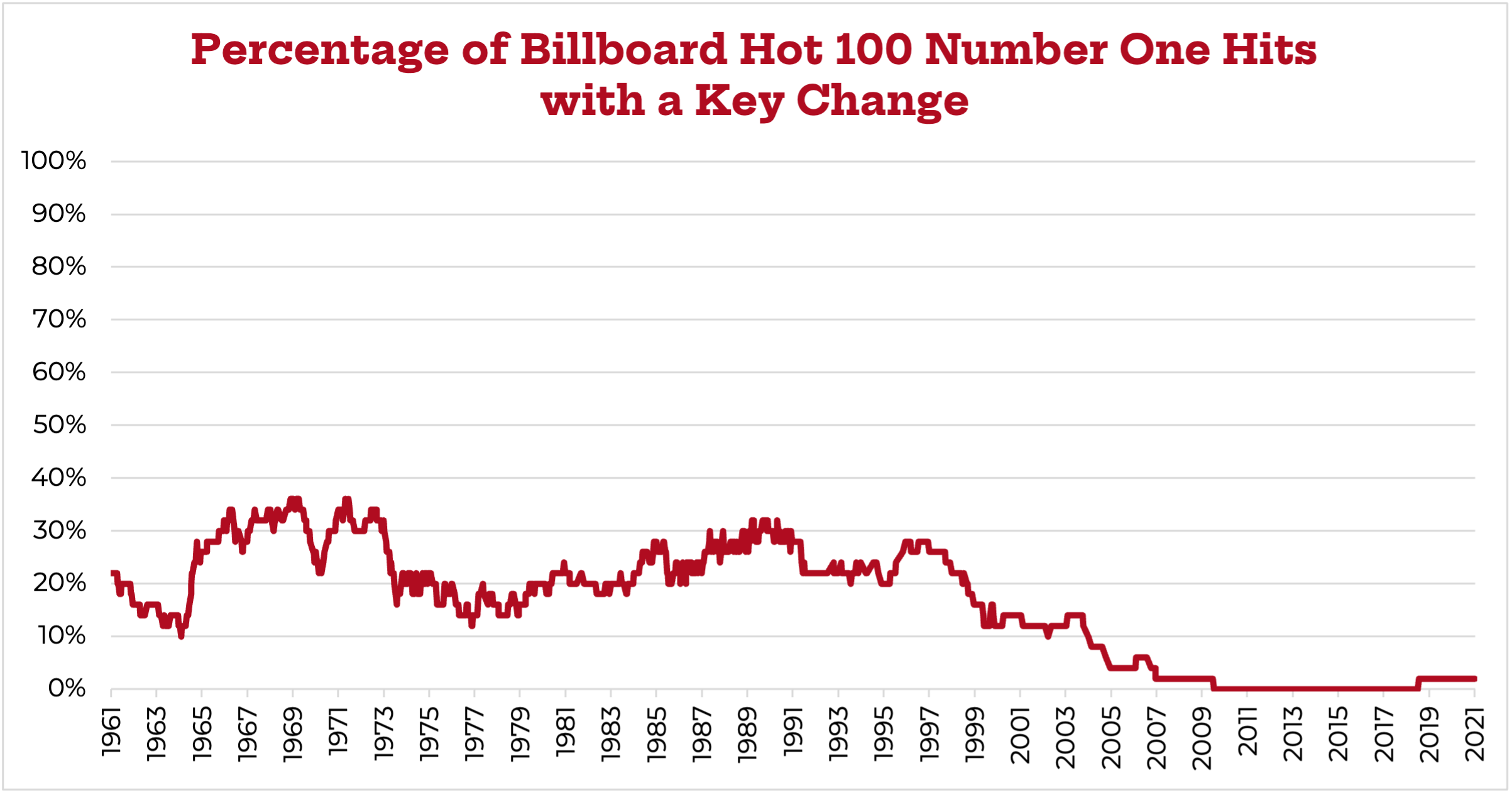
I can’t help but feel that something similar is happening culturally. We seem to be afraid of the future and more nostalgic than ever. It’s even hurting creativity. Songs don’t even have key changes anymore.

People have been predicting that DALLE 2 will disrupt graphic designers. But all the AI does is take inputs and say “this looks like something a human would create.” As far as I can tell, AI doesn’t have the ability to innovate and create new artistic styles, its creations are based on existing styles. Maybe this is what AI really disrupts, creativity.

Cancelled

People like to say that you can’t say the type of things that George Carlin said anymore, it would be too controversial. But that’s not entirely true, because Dave Chapelle says controversial things and people have been trying to cancel him for years. But what I think is true is that no up-and-coming comic could do Chappelle’s exact act and survive. Chappelle, like Cruise and Pitt, has built up enough of a reputation and a loyal audience to make it worth it for Netflix to keep platforming him, despite the number of people calling for his head.

He has what Erik Hoel calls “immunity to gossip.” In a popular Substack post, Hoel coined the term “gossip trap” to describe the default setting of most social groups that prevents the formation of civilization, and how we seem to be falling back into it.

“Being in the Gossip Trap means reputational management imposes such a steep slope you can’t climb out of it, and essentially prevents the development of anything interesting, like art or culture or new ideas or new developments or anything at all. Everyone just lives like crabs in a bucket, pulling each other down. All cognitive resources go to reputation management in the group, leaving nothing left in the tank for invention or creativity or art or engineering.”
For him, civilization was a solution out of the gossip trap.

“For what are the hallmarks of civilization? I’d venture to say: immunity to gossip. Are not our paragons of civilization figures like Supreme Court justices or tenured professors, or protected classes with impunity to speak and present new ideas, like journalists or scientists?”
I applaud Hoel for using a simple term like “gossip trap” to describe the phenomena, rather than something nerdy and opaque like “socialized stigma inertia”. But I still think there’s a better way to describe what he’s talking about.

Surviving popularity

Gossip is done behind people’s back. That’s not what we’re describing here. What we’re describing is this: someone who holds subjectively dangerous/harmful views is getting too much prestige (trying to climb out of the bucket) and we respond by pulling them back down.

This blog post best capsulated what I'm talking about (you have to scroll down until you get to the Caviar Cope section). I saw The White Lotus and thought it was okay. But many people in my social circle loved it. They all shared similar traits: left learning, highly educated, white, middle to upper class folks who tend to hate the wealthy. 

The writer notes that viewers of Succession, The Menu, and The White Lotus have this internal monologue like this:
"I would love to own a yacht, but I'm too smart and mentally healthy to be that rich. So I'll just watch these pathetic losers on their yachts, to enjoy the experience, while also basking in my superior intelligence and well-being."
The White Lotus leans right into the gossip trap. It tells the viewer, "You know how all wealthy people are evil? Come watch this show where they all get humiliated and you get to laugh at them." The show is an avatar for pulling people back into the bucket.

The Cancel Paradox

Hoel’s idea of the gossip trap is his attempt to answer the sapiens paradox: why did it take so long for humans to invent civilization. But he actually does a better job of answering the origins of our current cancel/accountability culture (a common criticism of the idea of cancel culture is that "it's just people finally being held accountable." Fine, you agree such a shift in norms has occurred. You're just quibbling about it's label. In my effort to be inclusive, I've used the phrase "cancel/accountability culture.").

My understanding of Steven Pinker’s Better Angels of Our Nature is that asking something like “why is there so much violent crime in east St. Louis?” is asking the wrong question when violence has been the norm for most of human history. Instead we should look at a quiet, low-crime community and ask why there isn’t violence.

So w/r/t the origins of cancel/accountability culture, maybe we’re asking the wrong question. Should be asking: how did we go so long without cancel/accountability culture? Hoel’s answer would be civilization, which involved building superstructures that create immunity from gossip/canceling. The cause of our current regression has been the age of information and transparency, which makes it easier to pull people back into the bucket with us and it’s made it harder for anyone growing up in this era to take creative risks when reputation management is so important.

From Lohan to Probst

But I’ve already said that gossip and high school culture isn’t the best metaphor for what’s going on. So what is? The TV show Survivor.

There are two ways to advance in Survivor. The easy way is to win competitions and gain immunity from being voted off the island. The other way is to not get voted off the island, which you do by getting people to like you, but not seeing you as a threat. 

This is where we are in our current culture. There is no more immunity so everyone is trying to be liked but not seen as a threat. (I should admit that I've never actually watched a full episode of Survivor.)

One of the most popular current comedians is Nate Bargatze. His secret? He never says anything offensive. Seriously, jump to the four minute mark in this bit he does about global warming. "Global warming, we gotta stop it. Or ... more of it? I don't really know which way we gotta go." He's gaining popularity because no one sees him as a threat. But if he ever works a political stance into a bit, watch the crabs come for him.

Civilization shrugged

This might explain our current cancel/accountability culture, but I’m still having trouble wrapping my head around Hoel’s point. He asserts that gossip is a “leveling mechanism” that has historically prevented, eg talented hunters from accruing too much power. These hunters are mocked and belittled by their peers and dragged back down into the bucket.

He then writes that civilization is a superstructure that levels leveling mechanisms. This seems to suggest that what allowed us to crawl out of the gossip trap and invent civilization was allowing individuals to accrue too much power. That’s some John Galt/Ayn Randianism shit right there.

If hunter/gatherer life is about tribes sharing the resources available (ie food), then agriculture/civilization is about increasing the amount of resources available and not sharing the new supply.

If this is true, then the libertarian mantra “the most common human trait isn’t greed, it’s envy” might be right. Capitalism isn’t about greedy powerful men exploiting poor workers and squirreling away resources for themselves. It’s about, well, greedy powerful men creating new resources and not sharing them as the rest of us look on with envy.

A Way Out?

So what would a superstructure that allows for creative risks and protects reputation look like? It might be Ontario's Human Rights Code. If you've been following any of the culture wars lately you may have read about a transgender teacher teaching a class while wearing large prosthetic breasts with protruding nipples. The school board has defended her right to do so, as she is protected by the law.

As far as freedom of expression goes, this example is a weird hill to die on. But in our current cancel/accountability culture, the fact that this unpopular personal decision is allowed to take place is proof that we can still create structures to climb out of the gossip trap.

Steelman Time

This seems to apply for comedy and movies, but not TV. We are in the golden age of television where creativity doesn’t seem to be a problem. So I think the gossip trap only applies to individuals who gain too much prestige. And the fact that I’m resistant to starting a new book or TV series might have more to do with the paradox of choice than some “end of culture” phenomenon.

But we'll wait and see. Maybe writers and producers have been around long enough to build up a reputation that immunizes them against cancellation. We'll have to see if the creativity stagnates with the next generation of writers and directors. 

But for now this is the best explanation I can come up with for the current culture war.