Friday, May 19, 2023

Updating my Priors: Short Takes 5/23

Two Matt Yglesias points reflect the Transparency Effect, the idea that things only seem to be getting worse because they are more transparent so we're just seeing more bad shit that was previously hidden. In fact, Steven Pinker might be right that things are actually better than ever.

"Officers were usually chosen based on political connections and bribery. There were no civil service exams or even formal training in most places. They were also used as a tool of political parties to suppress opposition voting and spy on and suppress workers’ organizations, meetings, and strikes. If a local businessman had close ties to a local politician, he needed only to go to the station and a squad of police would be sent to threaten, beat, and arrest workers as needed. Payments from gamblers and, later, bootleggers were a major source of income for officers, with payments increasing up the chain of command."
Second, newspapers used to be insanely corrupt.
“As Louis Menand explains in a recent review essay, back in “the good old days,” the press was often willfully deceptive and saw collaborating with government officials to mislead people as part of its job.”
And yet, both institutions are much less trusted than ever even though this level of corruption would seem unimaginable today!


Robin Hanson writes a post about why modernity seems so boring that seems to agree with the Gossip Trap theory.
“With friends, family, and close co-workers, we are around people that mostly want to like us, and know us rather well. Yes, they want us to conform too, but they apply this pressure in moderation.

Out in public, in contrast, we face bandits eager for chances to gain social credit by taking us down, often via accusing us of violating the sacred.”

“I see roughly three typical public stances: boring, lively, or outraged. Either you act boring, so the bandits will ignore you, you act lively, and invite bandit attacks, or you act outraged, and play a bandit yourself." 
The last part about acting boring was where I got my theory that Survivor is the best metaphor for how modern celebrities try to behave.


I saw a Tik Tok video of a young Gen Z woman saying something to the effect of “You don’t hate Mondays. You hate capitalism.” It reminded me of my post about how dialogue about conflict is usually an argument about aesthetics. For the Marxists and Marxist-adjacent, like the capitalism-hating woman in the Tik Tok video, the core of the belief might simply be that labor is ugly and society should be optimized around making the ugliness of labor as tolerable as possible.

I heard something similar on the Plain English podcast. Derek Thompson said that there is a group of people who believe that they cannot solve their own problem (eg depression) until they solve some society-wide problem (eg universal health care).


Not necessarily true, Neil. You might just have really good heuristics!


I made the case that higher education should stay away from public comments on the subject of morality, as it will hinder their credibility when it comes time to weigh in on topics of science. Now it looks like I have some evidence to back me up.


This article from The Atlantic shows that suicide rates went down during the pandemic. Confirms my priors based on the Sebastian Junger theory that tragic events that level hierarchies (ie the pandemic) can give a stronger sense of meaning and community. Plus, less school bullying. But I’m surprised it hasn’t been reported on until now, especially with all the other bad things that went up during the pandemic.


I thought this was interesting. My guess is that 40 years ago the bias would be in the opposite direction. I wonder how much the "boys are falling behind" narrative creates this bias, with teachers developing a prior that boys aren't as smart.


I once got into an online argument with someone regarding the topic of using shame as a method of persuasion. He referenced a study that showed shame worked for getting people to quit smoking, which I dismissed as that idea doesn't scale, i.e. it only works when used by family members. You can't shame some rando online into changing his mind about, say, systemic racism.

But I don't think I should have been as dismissive. If you can convince some non-trivial number of Republicans to, I dunno, support green energy initiatives, then their ability to shame their peers is more impactful than anything a Democrat could do.


This post by Lindy Man touches on a lot of the topics I wrote about here, even using the same references to Reality Bites and Fight Club to illustrate the non-conformity ethos of the ‘90s. But what I really want to draw attention to is the chart he cites from this Axios report.
People mean many things when they complain about “snowflakes.” But generally, I think they are talking about an increased sensitivity to emotional harm and favoring censorship as a remedy. A common thing you hear about regarding comedies, in what Lindy Man calls The Vulgar Wave (the period from 1990 to 2008) is that “you can’t make a movie like that anymore.” 

And maybe the Axios report offers the simplest explanation: women hold more cultural power than ever and their tastes are dictating art. This is a simpler answer than the Gossip Trap and so for now, I kinda have to favor it.

"A moral community seems like the one place where we can all agree that outsiders have no right to intrude. Just as Christians agree that Jews should be able to have their own temple to worship, woke NYT readers would have no problem with the National Review running the Tom Cotton piece. It's not that the column was wrongthink and harmful to minorities, it's where it appeared, in the sacred New York Times."
In recent news, Stanford Law School students shut down a speaker for his views. In the past, I've made the mistake of responding to this the same way as the following image. 
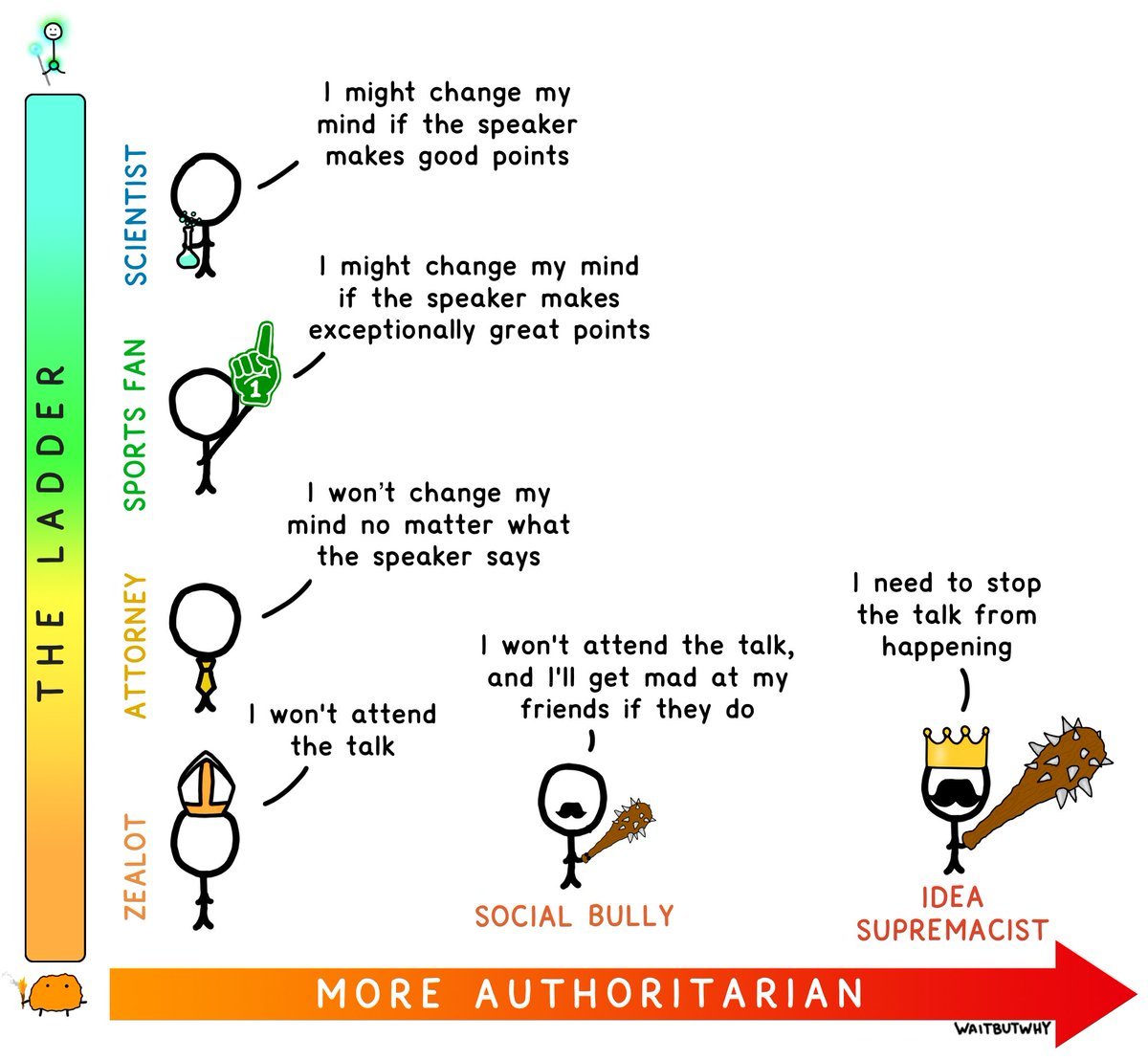

In other words, I viewed the students as Idea Supremacists, motivated to stop the talk from happening. But then I remembered that a lot of times in these campus situations, it ends not with the cancellation of the speech, but moving it off-site. 

This is important.

The next time you roll your eyes as some Gen Z student goes on about the need to create a safe space for vulnerable populations, try this experiment. Replace the word "safe" with "sacred."

This isn’t about censoring speech, it's about sacredness, the moral foundation of sanctity. These don’t students don’t want the speech to take place on their campus. Move it to a conservative church and watch the activists go home.  

And I don't blame the students. This is our fault as a society for failing to provide moral communities to people. 

It's like Derek Thompson's workism theory.
“work is not only necessary to economic production, but also the centerpiece of one’s identity and life’s purpose... 
In the past century, the American conception of work has shifted from jobs to careers to callings—from necessity to status to meaning.



Friday, May 5, 2023

Book Review: The Nordic Theory of Everything


I used to have this theory that the citizens of San Diego have more interesting conversations than the rest of us. The idea is that the default conversation topic for most people is to talk about the weather. But since there is no point in commenting on San Diego weather, since it’s always nice, they have to dig deeper for more meaningful dialogue.

In The Nordic Theory of Everything: In Search of a Better Life, by Anu Partenen, the Finnish-American author explains how the two countries she has called home differ. The policies of Nordic countries, she believes, are rooted in what she calls "the Nordic Theory of Love.” Much like my theory of weather-deprived conversations, the idea is that the government should supply services that strip away the interdependence of a citizen’s relationship to their family, and all the stress and anxiety that accompany it, so that all that is left is love.

For instance, in America the tax code incentivizes dependency on spouses—as any newly-divorced couple will discover the next time they file their taxes. Things get worse if they are on the same insurance plan.

Parents paying for their kids' college tuition incentivizes dependency on parents. When the government picks up the tab instead, these relationships become based on pure love, since the leverage and power dynamic is removed.

Like most untraveled Americans, I am fascinated at how Nordic countries can have such a robust welfare state and still have a functioning government and very happy citizens. And furthermore, could the U.S. adapt their model? Partenen answered most of my concerns but I still have two that remain unresolved. I am going to use this post to categorize the most salient quotes by topic and then address those unresolved questions in my conclusion.

Socialism

Socialism is one of those terms that can mean different things depending on who is using it. Both conservatives and DSA members call Scandinavian governments socialist, but they're just not. In fact, Partenen mentions that Finland, "fought three brutal wars against socialism in the 20th century to protect our freedom, independence, and free-market system.”

She continues:
“One of the reasons the Nordic countries have arrived in the future first is that after their 1990s financial crisis they set about reinventing their governments to nurture capitalism for the 21st century, making them less bloated, much more efficient, and more fiscally responsible. They did cut public spending and taxes, but they also invested in their people.”
One of the distinctions she makes is that the conversation shouldn't be about big vs. small government, but smart vs. inefficient government.

Individualism

She also stresses the individualism of Scandinavia. I don't totally buy it, I think they are more communitarian and homogenous than she realizes. But she makes some good arguments. 
“Nordic societies provide their citizens … with maximum autonomy from old-fashioned, traditional ties of dependency …. Nordic countries are, in fact, the most individualized societies on the face of the earth.”
Attending university costs a small membership fee. All students get a monthly stipend for living costs. 
“Imagine then what it’s like to be a Nordic parent. You can simply focus on raising a human being, in an age-appropriate way at every stage, without ever once feeling guilty that you’re not saving enough money, or not making enough money, to secure them the college education they’ll need to avoid ending up in the gutter.”

This example speaks to Partenen's Nordic Theory of Love: by providing tuition-free college, families are free from the burden that American parents feel and thus, their relationships are strengthened.  

School

Partenen quotes Pasi Sahlberg, saying: “In the Finnish language we don’t have the word accountability. It doesn’t exist… In Finland we think that accountability is something that is left when responsibility has been subtracted.”

What a great line. But not as good as the Finnish proverb: A child’s job is to play. 
“A typical daily program in a Finnish daycare center involves not just recess but several hours of outdoor play throughout the day.”
Students in Nordic countries, who overwhelmingly attend public schools, have some of the highest test scores in the world. Their closest competitors are the high-stress environments of Asian schools. This is having their cake and eating it too. Well done.

Parental leave

Nordic parents take a lot of time off. Like, a lot.
“The universal minimum amount of parental leave … is 9 months. Norway families can choose eleven months at full pay or 13 months at 80 percent. …

After the ten months of parental leave that are used up in Finland, one parent can still stay home, without losing his or her job, until the child turns three.”
This puts enormous pressure on co-workers. The work culture must be much slower-paced than in America, with all those moms and dads not there for long stretches.

But Partenen notes that American moms are more likely to drop out of the workforce. Due to generous leave, Nordic parents return to work.

Welfare queens

“... the key to keeping welfare queens … at bay is linking a person’s benefits to his or her previous salary.”

Only 7 percent of Finland is on the equivalent of welfare, compared to the U.S., which is 15 percent. Finland also has larger labor force participation. This is what Patenen means by smarter, rather than larger, government. A larger welfare state does not have to lead to fat and lazy welfare queens.

But the question remains: is the lack of abusing the system a policy design, or is it cultural?

Community

Partenen quotes the book Coming Up Short: Working Class Adulthood in an Age of Uncertainty by Jennifer M. Silva, writing: 
“Increasingly disconnected from institutions of work, family and community, [Americans] grow up by learning that counting on others will only hurt them in the end.”

“Tragically, America appears to be raising a new generation of young people afraid to form bonds at all…"
Partenen contrasts that with Nordic societies, which "have already transitioned toward … supporting the independence of the individual, so that the individual can then afford to make supportive and loving commitments to other people, like pairing up and starting a family.”

Healthcare

The usual sound bite is that Americans pay the most for their healthcare but we have the best doctors. But when you dig deeper, it gets more complicated.
“Another justification for the high incomes of doctors in the United States is the expensive malpractice insurance they’re forced to buy. In Finland, such costs are negligible.”
Ok, but why? Is it harder to sue or culturally a less litigious society? Partenen never really goes deeper.

Scott Alexander led me to believe that the reason American drugs are so expensive is that the R&D cost of getting them to the market (i.e. passing FDA hurdles) is so costly that Big Pharma needs to charge a lot to recoup those costs. 

Partenen counted with a big story that ran in Time. 
“Drug companies warn, of course, that if their profits in the United States were curtailed it would reduce their ability to innovate, but the research and development costs of major American drug companies are but a fraction of their vast profits. Drug companies spend more on advertising than on product development."
I went directly to the Time article and found this:
"In other words, even counting all the R&D across the entire company, including research for drugs that did not pan out, Grifols made healthy profits."
Scott ...

There was also some good parts on the effects of the healthcare system we have chosen and the ways to pay for its inefficiency. 
“Unpaid medical bills fall either on taxpayers, as government money flows in to subsidize hospitals that provide charity care, or they fall on other individuals, when hospitals raise their prices to cover their losses, and when insurance companies raise their premiums to cover those higher prices… The current system in the united states, even though we may not notice it, isn’t just bad in terms of getting health care, it also literally tears apart the social fabric of the nation.” 
My mother-in-law told me that, as an occupational therapy assistant, she had the option of earning wage X as a part time worker or earning wage Y as a full time worker, with X>Y. The reason being that part time workers are not offered benefits, like health care, so they can afford to pay her more.

One of the benefits of eliminating our employer-based health insurance system is that your employer can now pay you more money. We don't realize the hidden cost of our wages being eaten up by our benefits.
“Currently U.S. employers that offer their employees health insurance, like those that offer parental leaves, are at a disadvantage compared with those who don’t. They’re also at a disadvantage when competing with companies in other countries with public health care. Many American employers have already hinted that they’d be more than happy to drop the burden of providing health insurance and instead offer their employees higher wages, or support for purchasing their own health insurance. ObamaCare forced big employers to keep offering health insurance, whereas a public option would free both employers and employees from the absurdity of health care that’s tied to employment.” 
Trust
“Trust in the medical profession as a whole in the United States had plummeted since the 1960s. Of the 29 countries [in a Harvard study], the United States came in twentieth fourth in the proportion of adults who trust doctors.”

“As I interviewed Nordic citizens about their health care, I was struck by how understanding they were of the need to keep costs at bay and to offer care to the neediest… In the United States, the prevailing feeling seems quite the opposite: that insurance companies are the enemies of the common people, and thus should be squeezed out of every penny possible…

It is difficult for Americans to know what they are missing. Europeans can feel enormously proud of and even patriotic about their health-care systems because they pay for them with their taxes…” 
This all sounds nice in theory. I wish we could expand our public services and increase institutional trust. But trust is not downstream from policy. If that were the case, Americans would feel the same way about our tax-funded schools as Finns do about their healthcare system. And we just don't.
“[Americans] tend to consider taxes as money taken from them, and tax breaks as a … correction. Cash benefits, by contrast, are seen as money received.” 
Finnish families receive cash each month, whereas US families get things like the EITC. She might be right here. Stimmy checks were pretty popular, until they caused massive inflation. But this could be a good case for something like UBI being a popular government program that increases institutional trust.

Elder care

Again, just another example of the Nordic Theory of Love as it relates to elder care:
“Having a public system that will take care of the fundamentals and the most difficult aspects of care, actually frees up family members to provide truly loving care for their aging relatives in ways, and amounts, that are not overly taxing or exhausting.”
Culture
“In the end, could the Finnish model truly be applied to a country as diverse as the United States? Do Finland’s policy choices—the supply approach, universal day are, ambitious teacher education, lack of standardized tests, in-school tutoring, short schooldays, and cooperation—really explain Finland’s success? Or is the reason for it actually much simpler: That Finns are all the same”
Interestingly, she never really comes back to that last question. But she does double down on the policy->happiness bit.
“All these achievements should not be dismissed as products of unique Nordic circumstance and culture. These achievements may have been inspired by the Nordic theory of love, but they are not achievements of culture, they are achievements of policy.” 

“When a company or a country does well and there is more wealth to share, workers can take their cut in either money or free time. Nordic workers often prefer to take time over money, because at a certain point, the secret Nordic people know is that time off buys you a better quality of life than more cash.”
There is a big subject that Partenen mostly avoids, which is the homogenized, monoculture of Scandinavia. She only gestures briefly at it in one instance, writing:
“The Nordic habit of conformity can be particularly hard on immigrants. Sweden is widely admired for its generous immigration policy, but on the whole many immigrants to the Nordic region find its citizens cold, hostile, and closed-minded.”
Conclusion

One of the best arguments of America being a go-go capitalist country that should not take its foot off the gas is that, in essence, we subsidize the socialist policies of much of the industrialized world.

So it's worth asking if higher U.S. taxes on the wealthy will hamper investment and growth to the point that global markets are affected. Let's just take the parental leave example. If we pull, say, twenty percent of the U.S. workforce out for two years and increase taxes to pay them for their time off, that is going to have some impact on economic growth. I mean, I think we will be fine but that slowdown is going to have global effects. Other countries are going to feel it when most of their retirement investments are tied to U.S. stocks.
By country, the largest stock markets as of January 2022 are in the United States of America (about 59.9%), followed by Japan (about 6.2%) and United Kingdom (about 3.9%)."
Also, most of the new drugs come from U.S. pharmaceutical companies. So when places like Canada impose cost controls, that just means U.S. consumers are left to foot the rest of the bill. Imagine if we decided to not sell drugs to those countries unless their consumers shared the burden that U.S. consumers pay. They would not have access to many powerful medications. 

Whether through trade or investment in global stocks and bonds, Nordic countries (and pretty much all countries) are reliant on U.S. wealth being as strong as it is. 

It feels safe to say that, when compared to America, Nordic countries work less, which means they have less wealth. So if the U.S. adopted Nordic policies, there would probably be less wealth; which would affect EVERYONE. Is the world better off with America working and producing as much as we do?

(I mean, I think the answer is that we should adopt more "socialist" policies but I wish people would at least grapple more with the tradeoffs.)

Finland So White

The other issue that never gets resolved, and I've been hinting at this entire time, is the issue of culture. Nordic countries are very homogenous (read: white), which leads to high levels of trust. You cannot implement these policies without trust. Trust comes first, it's not the other way around. You just cannot take a country with our history of chattel slavery, segregation, and the treatment of indigenous people—not to mention our sky-high affective polarization—and think you can fix things by offering free healthcare, better schools, and paid parental leave.

Even if you could build "smart" government programs, people would abuse them or find ways to denigrate and dismantle them, just as the Republicans have tried to do with Obamacare. 

I'm still convinced that America needs to fix our trust issues before we can have a better government.

Friday, April 14, 2023

Hope is a Good Thing

I recently stumbled across a 2021 song called “Hi Ren” by the artist Ren. Check out the video above. The vibe of the song is familiar but still impressive. But after a few listens I realized that the song went in a new direction I was not expecting.

In one part, Ren breaks the fourth wall and mentions how Eminem and Plan B have already done similar songs to the one he is doing. But I actually think the closest comparison is “U” by Kendrick Lamar. Both songs are the artist, as themselves, having a conversation with themselves about self doubt.


"U" is one of my favorite songs for the same reason that Rue from Euphoria is one of my favorite characters. In one episode, Rue is shown staring at the ceiling and envisioning numbers on a grid and becoming so transfixed that she could not function. In another episode, her mother explains how, as a child, if she kissed Rue goodnight on one cheek she would have to do the same on the other cheek.


One of the best feelings in the world is the feeling of being understood, especially when it seems that no one else understands you. As a child with OCD, I had very similar experiences to Rue and those moments really made me feel seen and understood.


Popular music in the ‘90s was depressing. But young people wanted it that way because it made their depression feel understood. I think the same type of person likes songs like “Hi Ren.” It is the same reason youth are self-diagnosing themselves with various disorders and conditions they hear about on social media. It is the same reason every personality has its own student club.


But there is a problem. Being understood feels good but it’s not a solution. It's like learning the cure for a hangover but continuing to binge drink.


Amanda Ripley wrote a great article about what she feels is a failing of the news. If the news is bleak, by all means, report on the bleakness. But you can still offer hope.


At one point, Ren, singing as his evil alter ego, says things like:

Oh your music is thriving? Delusional guy!
Where's your top ten hit? Where's your interview with Oprah?
Where are your grammies Ren?
Nowhere! ...

Man you sound so pretentious!
Ren your music is so self centred,
No one wants to hear another song about
How much you hate yourself.

That compares well with "U" in which Lamar raps:


I fuckin' tell you fuckin' failure—you ain't no leader!
I never liked you, forever despise you—I don't need ya!
The world don't need ya, don't let them deceive ya
Numbers lie too, fuck your pride too, that's for dedication
Thought money would change you, made you more complacent
Fuckin' hate you, I hope you embrace it,


And while "U" ends with a hint of suicide, Ren goes in a different direction. Speaking as himself, he sings:


Some people know me as hope

Some people know me as the voice that you hear

When u loosen the noose on the rope

And you know how I know that I'll prosper?

Because I stand here beside you today

I have stood in the flames that cremated my brain

And I didn't once flinch or shake

So cower at the man I've become

When I sing from the top of my lungs

That I won't retire I'll stand in your fire

Inspire the weak to be strong


As a society, I think we’ve done an admirable job of normalizing mental health, encouraging suffering people to speak up. But we haven’t done enough to valorize the process of getting better.


Friday, March 17, 2023

Agency Detection and The Confident Pundit

A face designed by some higher power, or just randomness?


I recently had a conversation with a friend and, as usual, we talked about Joe Rogan and conspiracy theories and it made for great blog content.

“Was Fauci compromised by big pharma?” was one of the questions we got hung up on.

One thing we share is that we do not have a lot of information on this topic. As such, we rely on heuristics. And so our disagreement was less about facts and more about which heuristics to rely upon.

I noticed that he was using two common System One, intuitive heuristics: the evil agent heuristic, and the confident pundit heuristic. Because these are intuitive, I think we are all prone to them. I just think there are better, more rational, more System Two heuristics that we should be using.

The confident pundit heuristic

We are naturally drawn toward confidence and, with low levels of information, will put our trust in a confident pundit who claims to have the answers.

Although intuitive, it actually makes sense if you don’t think about it for too long. A confident pundit is putting their reputation on the line, putting skin in the game, so why wouldn’t I believe him? Unfortunately, our current system does not penalize people for being wrong. It’s too easy to move goalposts and double down, especially when the confident pundit rarely says anything specific enough to be proven wrong. Most people have a self-preservation bias and will do mental gymnastics to avoid admitting they were wrong when they stake so much of their reputation to their hot take.

So Bret Weinstein is highly confident when he speaks about his vaccine conspiracy theories. And I don’t have much information, so I can’t challenge his assertions. But his confidence doesn’t move me because he’s really not saying anything falsifiable.

If he said, “Because of my assertions, I predict that the number of people dying from heart related conditions will increase by 25% starting in 2024, and the increase will be entirely among the vaccinated,” I would take him very seriously! But he mostly says things that sound like “we don’t know what these vaccines are going to do and they haven’t been properly assessed.” So his confidence does not move me as it isn’t falsifiable—specific, measurable, and timely. There is nothing he says that we can point to and say “see you were right/wrong!”

So I tend to distrust confident pundits whose opinions are outside the consensus. 

The evil agent heuristic

Agency detection refers to our in-born tendency to look for a man behind the curtains. It’s the reason we see faces in the clouds, but not clouds in faces.

We know the reason some clouds look like elephants isn’t due to God making fluffy balloon animals for us. It’s just randomness; there are many clouds, their shapes are random, and so ever so often one looks like a familiar mammal. So we should extrapolate from there and assume that if we have low levels of information, strange events are probably more likely randomness, like the random shape of clouds and our agency detection thinking they look like Elvis, than evil manipulators making these shapes.

UC Santa Barbara conducted a study where they tested people's abilities to find hidden patterns. Half of the subjects, before the test, either read a Kafka story or watched the David Lynch film Blue Velvet. If you've never seen Blue Velvet, the immediate reaction from most normal people is "What the fuck did I just watch?" In other words, the plots don't make any sense. Those people's scores where better, statistically significant, than the control group.* 

One of the study's psychologists said: "The idea is that when you're exposed to a meaning threat –– something that fundamentally does not make sense –– your brain is going to respond by looking for some other kind of structure within your environment."

JFK

I don’t have a lot of information about the JFK assassination, since I don’t find the topic interesting. But there is one theory that I like.

As far as I understand, the part that doesn’t make sense is that one bullet appears to come from the opposite direction than the ones fired by Oswald, which exposes people to a "meaning threat". This is what leads to the “magic bullet” or second shooter theories. The fact is we do not have much information, which leads to conspiracy theorists who begin with agency detection and the evil manipulator heuristic, and end with the belief that the CIA was behind everything.

The theory I like goes like this. Kennedy’s secret service agent was beside him when he got shot. He reacted by quickly pivoting and returning fire in the direction of Oswald, and Kennedy’s head got in the way, which explains the “magic bullet.” In essence, Kennedy’s own secret service agent was unintentionally the second shooter. The reason for the secrecy is that, well, it’s embarrassing.

Now, this theory is probably just as plausible as anything you’d find in any conspiracy book. But it’s much less popular for the simple fact that it’s fucking boring. There is no evil agent to blame. So given low levels of information, and a high ratio of randomness to evil, I favor the boring explanation.

But sometimes there is evil and the conspiracy theorists are right! Does that mean my boring heuristic is garbage and assuming evil is always the right choice? That depends on how you feel about the Blackjack scene from Swingers.

Always double down on 11

Is Trent (Vaughn) right, or is Mikey (Favreau)? We’re probably asking the wrong question because Trent is actually talking about broad framing. Trent is asserting that if you follow the “always double down on 11” heuristic, in the long run, you’ll make money. Mikey is caught up on his granular experience and how he lost by following that heuristic. (Technically, Mikey is right. If you’re broad framing, you need to have enough capital to avoid going bust after a few initial losses. Plus, there is no successful heuristic in gambling, the house plans for it and always tips the odds in their favor.)

But the point is that Trent and Mikey, like my Rogan-loving friend and I, aren’t arguing about facts but about heuristics. And heuristics shouldn’t be judged on a case-by-case basis, but how often they’re right in the long run.

So my yet-to-be-proven belief, is that if you follow the boring fallacy you will be right more often than the evil fallacy or the confident pundit. I also have an anti-confident bias so I avoid individuals who are overconfident and arrogant, except for a few arrogant people I think are usually right (Nassim Taleb, Eliezer Yudkowsky). Instead I rely on a consensus of experts or pundits who give specific, measurable hot takes; bonus points if they use a confidence interval.

*If the UCSB study was a better example, then it would have shown that the Kafka/Lynch subjects found more false positives (i.e. identified patterns that weren't actually there) than the control group. But this is my favorite study ever and I've been working really hard to find a way to work it into a blog post, so deal with it.

Monday, February 13, 2023

Photoshop is Obsolete. Long Division should be next.


This is a post about why I hate long division. But to get there, we have to talk about Photoshop color modes.

When you open an image in Photoshop, you have the option of choosing one of three color modes (plus grayscale if you want it to be black and white). The default is RGB, which stands for red, green, blue. Any color that shows up on your screen can be reduced to a value between 0 and 255 for red, green, and blue. For instance, an RGB of 53, 94, 59 will give you a nice hunter green color.

The other popular color mode is CMYK; or cyan, magenta, yellow, and black (the k actually stands for “key” but for all intents and purposes let’s call it black). Same thing: you give a value to each of the four colors and that unique combination will produce whatever color you are looking for. This is the color mode used for printing. Open up any commercial grade printer and you will see four toner cartridges labeled, you guess it, cyan, magenta, yellow, and black.

Photoshop also offers a color mode called Lab. The L is for lightness and the a and b are a range of colors, green to red and blue to yellow, respectively. When I was going to Photoshop conferences (a real thing) the Photoshop gurus (real people) were super excited about Lab.

Normally, if you wanted to adjust the lightness of an image (make it darker or brighter) you would use a Photoshop tool like Curves or Levels. Sometimes this had the unintended effect of also changing the value (ie shade) of the colors. So lightening an image might accidentally turn a red pixel into a pink one. Lab solved this by putting lightness on its own channel. Finally, a solution to a problem that only 1% of people actually notice!

Crowding In
All of this is to say that I have a deep knowledge of Photoshop. Most amateurs are interested in learning Photoshop because they want their images to be brighter, darker, sharper, or just to “pop". I had learned myriad ways to get inside images and make them pop.

Then Instagram filters came along and suddenly everyone could do what I could do. Even the default photo editing app on your phone does a good job. At first, I found ways to criticize these techniques; “this isn’t print quality” or “it looks fake,” but it is serving the intended purpose of the user; making it pop so they can share it online.

This trend has continued with Canva, turning any amateur into a halfway decent graphic designer. In fact, this trend started with digital photography in the ‘90s, which made it easy for anyone to be a decent enough photographer. Most non profit marketing teams don’t have a photographer, they just hand a camera to someone (usually the media relations guy) and say “figure this out.”

And he does. It’s not that hard to take “good enough” photos.

All of this has been bad for people who built their careers being highly-sought after professional photographers, graphic designers, and photo editors. But it’s made it really easy for people who cannot afford these services who can now do a “good enough” job and produce more content.

That is the crux of my point; the democratization of the tools didn’t kill my job. I do more digital than print content now, so I just spend less time tweaking photos in Photoshop and more time producing content, which is really what my job is.

Bad Math Dad
I have a ten-year-old who occasionally (when my wife is unavailable) asks me for help with his math homework. Sometimes I can help, but usually I get incredibly frustrated and launch into a tirade about how pointless it all is.

I usually stop there, but this time I decided to lean into my own self righteousness and develop a solid argument for why it is pointless, which you are now going to read.

The fact that I can’t remember complicated long division or how to multiply fractions is a pretty good indicator that learning it was useless for me. That’s not to say math is useless; it’s incredibly important. I use it every day. I just do it with a calculator.

You might counter that not all math can be done via calculator, and that’s exactly my point. Why do we waste time teaching kids things they will end up doing on a calculator? Why not just teach them how to use a calculator to solve simple problems.

Fast Tracking Innovation
Social media managers don’t need to understand color correction in Lab mode. They just take a photo on their phone, make adjustments, and post it to Instagram.

I read somewhere that society advances when we increase the number of things we can do without thinking about it. So how much quicker could we move students along to doing really exciting things in math if we aren’t wasting time with trivial things like memorizing times tables?

There is a story about an elementary school that dropped math from the curriculum, beyond some teaching some basic practice in measuring and counting. Those students rejoined the rest of the district in middle school, with students whose elementary schools had taught them math, and by the end of the year the non-math students' math scores had caught up with everyone else. 

The school dropped math for budgetary reasons, but what if money isn’t an issue for your school? How would you use those extra learning hours to advance knowledge?

My fear is that the reason we still teach these building blocks is the reason some photoshop mavens hate Instagram; it makes their deep knowledge and experience irrelevant.

But I think we have to put the kids first and get past all that. How many kids are we losing each year by forcing them to learn boring, rote memorization of pointless skills they will never use manually? How much sooner could the next generation of math whizzes reach breakthroughs and innovations if they didn’t waste so much time learning building blocks and instead stood on the shoulders of the amazing calculators our society has invented for our convenience?

Or maybe I just really suck at math and this is all cope.

Friday, February 10, 2023

Short Takes: Updating my Priors 2.2023

I once wrote a post pontificating that perhaps the reason US history was told with no contradictions, with America as the hero, was to create a myth to unite a diverse group of citizens. But I think a more likely answer is that a simple narrative is just easier to remember. 

As me move toward a messier, more complicated retelling of our story, my guess is that more students are going to lose track of the overall picture.

Interesting thread on happiness that mirrors my post on trust. Some similarities, poverty and inequality lead to low trust and happiness. It also complicates two of my views: I'm okay with inequality as long as we take care of the people at the bottom. But I also highly value trust, which seems incompatible with high inequality.


Speaking of trust and social capital, I’ve speculated a lot on the decline of social capital; why there is less face-to-face interaction with people outside our homes in younger generations. But maybe the better question is to ask why there was so much face-to-face interaction with the silent generation. 

And maybe the simple, boring answer is that civic participation and social interaction is driven by boredom. And entertainment and technology is so amazing right now that people are never bored enough to leave their homes and find other people to cure their boredom.

I also think this is a better explanation than the one offered by the Let Grow movement, i.e. that kids are stuck inside because their parents are too scared to let them out. My theory is that they don’t want to go out. The idea of meeting up with some neighborhood friends and building their own treehouse is less exciting than doing the same thing virtually on Minecraft.

In my End of Culture post, I pointed out that the proliferation of new movies that are sequels (Top Gun: Maverick, etc.) and TV shows that are spinoffs (Velma, Wednesday, etc.) are a sign of a lack of creativity driven by the Gossip Trap. 

But I think there is a better explanation. 

Research shows that, given low information, a voter will choose the candidate with the familiar name. Likewise, given an abundance of streaming options, and the paradox of choice, a viewer will choose a familiar-sounding show. So spin-offs and sequels are a way for content makers to cut through the noise by giving the viewer a familiar-sounding name.

In The Scout Mindset, Julia Galef uses the example of a climate activist using investment language as an analogy to change the stance of a climate skeptic who worked in finance. I was thinking of this when reading NYT’s "The Morning" when it quoted Biden’s line about going after “junk fees.”

Not knowing much about junk fees, I would have defaulted to feeling like this was some government overreach effort that is probably a net harm, especially if I read it in a column by a leftwing activist with language like "corporate greed" and "the evils of capitalism". But watch how David Leonhardt frames it.

“True, one company could call out another for using [junk fees]. But doing so often requires a complex marketing message that tries to persuade people to overcome their psychological instincts (like the appeal of a low list price). For that reason, Hilton can probably make more money by charging its own sneaky resort fees than by criticizing Marriott’s.”
In other words, our current, unregulated system penalizes companies that don’t engage in junk fees. If they want to stay competitive they have to do it too, even if they don’t want to. The government, in this case, is just resetting the nash equilibrium so there is no longer an incentive to opt out of the prisoner’s dilemma.

I mean, that worked for me. And it reminded me why viewpoint diversity is important for persuasion; you have to know how other people think and talk if you want to change the way they look at things.

Friday, January 27, 2023

The Beautiful


I’ve been struck by this passage from a rationalist essay. It imagines two people arguing over whether minimum wage laws are helpful or hurtful, both citing facts to support their respective cases. Then it zooms out and suggests that it’s really a conversation about aesthetics. In other words, they are really arguing about whether capitalism is beautiful or ugly, which is why facts are often unpersuasive.

(The lead photo of a dense collection of gas stations in Breezewood Pennsylvania is a meme that socialists like to use to argue that capitalism is ugly.)

In The Happiness Hypothesis, Jonathan Haidt describes a patient who has brain damage affecting the emotional part of his brain. Ostensibly, he seems completely normal. But after several failed relationships, he sees a shrink. At the end of a session, the doc asks when he wants to book the next appointment. The patient lists the pros and cons of all possible dates, but cannot decide because he cannot assign any emotional valence to anything. He’s always stuck.

It’s an interesting case study because it suggests that humans actually need to be a little bit emotional in our decision-making. We need to see the beauty in things.

In Zen and the Art of Motorcycle Maintenance, the narrator describes his friend's relationship to his motorcycle. His friend bought a BMW because he didn’t want to deal with any problems. But they invariably happen.

The narrator tries several times to show his friend how to fix his motorcycle, but he stubbornly refuses to even listen. It’s not that he’s lazy or incompetent. Instead, the narrator describes him as a romantic thinker who sees the beauty of the motorcycle, but breaking down its component parts is ugly to him.

So it wasn’t a question about whether or not he should learn how to fix his own motorcycle, it was a question of whether the mechanical parts of a motorcycle are beautiful or ugly.

I think this framing is helpful because sometimes it’s the reason people in dialogue get stuck; they’re arguing about beauty. And you can’t, and shouldn’t, try to convince someone that what they think is beautiful is not.